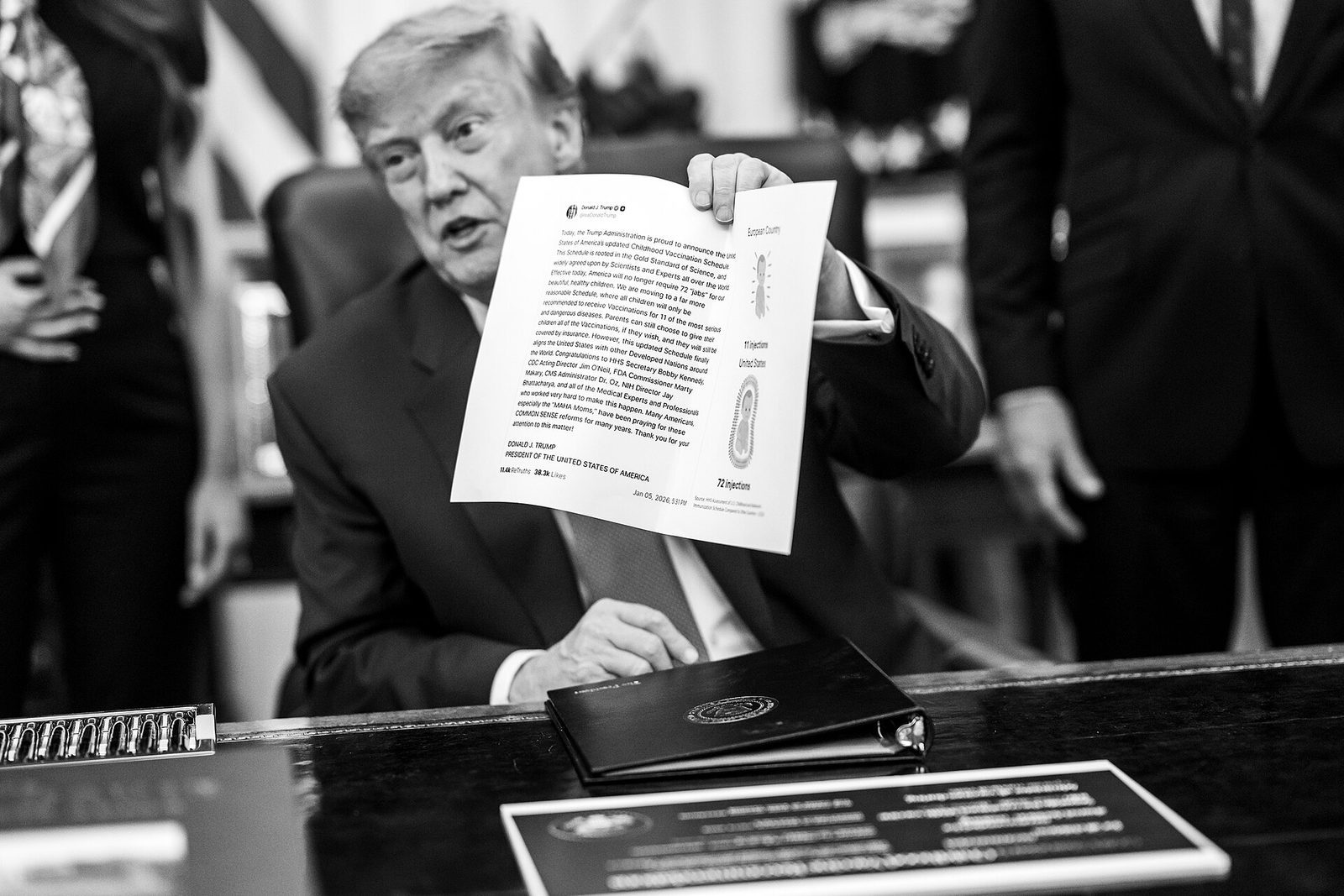
Order trims universal child vaccines to 11 diseases
An August 2026 executive order re-asserts schedule cuts a federal judge had blocked and calls for splitting the MMR shot into three.
Key facts
- Universal list cut to 11 diseases from 18
- Hep B, rotavirus, flu, COVID moved to high-risk or shared decision
- CDC schedule cuts still blocked by March injunction
Summary
On August 10, 2026, President Trump signed an executive order establishing 'Gold Standard Childhood Vaccine Recommendations' that recommend routine immunization of all children against 11 diseases, down from 18 under the CDC's recommendations, shift the rest to high-risk or shared clinical decision-making categories, and call for splitting the combined MMR shot into three single-disease shots.
What happened
Executive Order 14420 lists 11 diseases for universal childhood vaccination (measles, mumps, rubella, diphtheria, tetanus, pertussis, polio, Hib, pneumococcal disease, HPV and varicella) and places hepatitis A, hepatitis B, rotavirus, meningococcal disease, influenza and COVID-19 in high-risk or shared-clinical-decision-making categories. It gives an HHS task force 90 days to present plans to offer core childhood vaccines as single vaccines, 'starting with MMR,' advises states to review school-enrollment requirements against the new recommendations, and directs the Attorney General to 'take appropriate measures to further meritorious legal actions challenging State laws' on grounds including parental authority and religious freedom. The White House said the 2024 schedule included 'at least 84 vaccine doses in at least 57 shots for 17 diseases' and that the US recommends more childhood vaccines than peer nations. The order restates cuts the CDC made in January 2026 that a federal judge blocked in March (see childhood-vaccine-schedule-stripped); on August 21, HHS followed with a request for information on whether to add new categories to the vaccine recommendation framework.
Impact on the United States
Pediatric vaccine recommendations for six diseases are downgraded by presidential order while 2026 US measles cases (3,659 as of September 24) already exceed any annual total in 35 years, leaving parents and clinicians with conflicting federal and professional guidance; the American Academy of Pediatrics' president warned that splitting shots means more visits, more time off work and more time out of school. By late September the CDC had not recommended a newly FDA-approved mRNA flu vaccine, citing 'legal uncertainties and inquiries', and private insurers were following medical societies' vaccine choices.
Documented effects
- Universal childhood vaccine recommendations cut to 11 diseases from 18; hepatitis A and B, rotavirus, meningococcal disease, flu and COVID-19 moved to high-risk or shared decision-making[1][2][3]
- Order calls for separating the combined MMR vaccine into three single-disease shots and gives an HHS task force 90 days to plan single-vaccine options[1][2]
- DOJ directed to support legal challenges to state vaccine laws on grounds including parental authority and religious freedom; states advised to review school-entry requirements[1]
- Legal experts said the changes would almost certainly be blocked by the courts and that the CDC is not obligated to adopt them[3][4]
- HHS published a request for information on August 21, 2026 asking whether to add new categories to the vaccine recommendation framework[5]
- By September 25, 2026 CDC had not recommended the newly FDA-approved mRNA flu vaccine, citing 'legal uncertainties and inquiries'; private insurers were following medical societies' vaccine choices[6]
- Context: CDC counted 3,659 confirmed US measles cases in 2026 as of September 24, with kindergarten MMR coverage down to 92.4% in 2025-26 from 95.2% in 2019-20[7]
Why this is rated significant
A presidential order re-asserting childhood-schedule cuts a federal court had blocked, moving hepatitis A and B, rotavirus, meningococcal, flu and COVID-19 vaccines out of universal recommendation and directing DOJ to back challenges to state vaccine laws, while 2026 measles cases exceed any annual total in 35 years; its direct effect is limited while the injunction stands.
Executive Order 14420; the CDC schedule cuts it restates remain blocked by the March 16, 2026 court injunction
Corrections & updates [2]
Every change to a fact on this page after publication is logged here, newest first.
- ClarifiedKey facts
Clarified that the order moves these vaccines into high-risk or shared-clinical-decision-making categories, not only shared decision-making.[1]
- Previously
- Hep B, rotavirus, flu, COVID moved to shared decision
- Now
- Hep B, rotavirus, flu, COVID moved to high-risk or shared decision
- ClarifiedSource labels
Source tier labels brought in line with the site's tier rule (specialist and trade publications are Tier 3; general news organizations are Tier 2): STAT News (Tier 2 to 3). No claim in the entry changed.
Sources [7]
- T1The White House - Delivering Gold Standard Childhood Vaccine Recommendations for Americans · Aug 10, 2026 ↗
- T1The White House - Fact Sheet: President Donald J. Trump Delivers Gold Standard Childhood Vaccine Recommendations for Americans · Aug 10, 2026 ↗
- T2NBC News - Trump order aims to cut number of diseases all children should be vaccinated against from 18 to 11 · Aug 10, 2026 ↗
- T3FactCheck.org - Trump and RFK Jr. Repeat False and Misleading Vaccine Claims · Aug 11, 2026 ↗
- T3STAT News - HHS document offers new clues to Kennedy's vaccine plans · Aug 21, 2026 ↗
- T2Associated Press (via News4JAX) - CDC vaccine policy recommendations grind to a halt under Health Secretary Kennedy · Sep 25, 2026 ↗
- T1Centers for Disease Control and Prevention - Measles Cases and Outbreaks · Sep 24, 2026 ↗
Image: Official White House Photo by Molly Riley, Public domain (Wikimedia Commons)