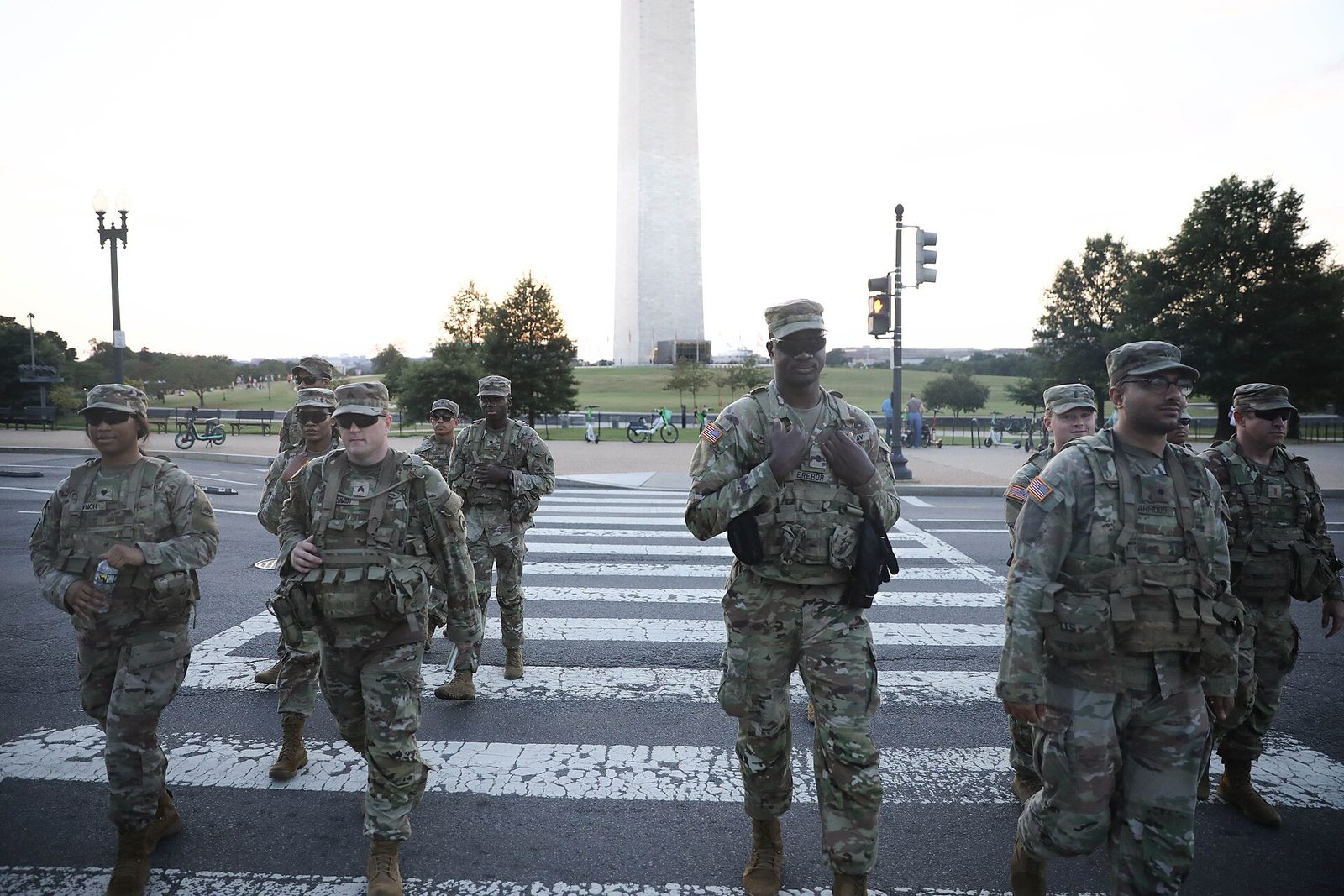
Troops in the capital, through the whole term
The DC National Guard deployment was extended to January 2029 and peaked at ~5,000 troops in a summer 2026 surge, despite studies finding little effect on violent crime.
Key facts
- Extended to Jan 20, 2029 'or until terminated'
- Summer 2026 peak of ~5,000 troops from 20-plus states; ~4,000 by August
- Two studies found little to no effect on violent crime
Summary
In mid-July 2026, the administration extended Trump's National Guard deployment in Washington, DC through January 20, 2029 (the end of his term) 'or until terminated by the President,' and the force nearly doubled to about 5,000 troops from more than 20 states. The deployment, begun under an August 2025 crime-emergency executive order, has drawn criticism as unnecessary; two studies found the troop presence had little to no effect on violent crime.
What happened
Federal officials extended the DC Guard mission - originally justified by a declared crime emergency despite crime near multi-decade lows - by more than two years, to January 20, 2029. Troop numbers rose to nearly 5,000 from more than 20 states. More than 20 governors, plus Puerto Rico and the U.S. Virgin Islands, sent Guard members; many Democrats among them said their troops were only to support America 250 celebrations. Two studies, including one by the progressive Center for American Progress, found the Guard presence had little to no effect on violent crime and that the decline would likely have happened regardless.
Impact on the United States
Entrenches a standing federal military and law-enforcement presence in the nation's capital for the remainder of the administration, at large ongoing taxpayer expense and with minimal demonstrated public-safety benefit, further normalizing domestic use of the National Guard for policing.
Documented effects
- DC National Guard deployment extended to January 20, 2029, 'or until terminated by the President'[1][2]
- Force nearly doubled to ~5,000 troops from 20-plus states in a 'summer surge' announced in May 2026[1][3]
- Two studies found the Guard presence had little to no effect on violent crime[3]
- The Defense Department told Congress that keeping the mission through January 2029 will cost about $1.4 billion ($605 million in FY2027, $626 million in FY2028 and $198 million in FY2029), assuming an average of 2,500 Guard members[4][5]
- Troop levels fell to about 4,000 in August 2026 from a summer peak of about 5,000 and were expected to settle at 2,500-3,000; a $292 million contract was signed to move troops into apartments[6]
- A Niskanen Center analysis found a 24% decline in property crime coinciding with the Guard presence but no reduction in violent crime attributable to the deployment[5][6]
Projected cost to Americans
Cumulative cost if current policy holds: direct federal cost plus the broader economic burden. A conservative, lower-bound estimate (medium confidence).
- So far
- $0
- By 2035
- $1.43B
- By 2040
- $1.43B
How this is calculated: Forward cost only. The Defense Department's written answer to Sen. Warren (provided by comptroller nominee Jules Hurst III, reported Aug. 4-5, 2026) estimates keeping the mission to Jan. 20, 2029 at $605.1M in FY2027, $625.8M in FY2028 and $198.3M in FY2029, "$1.429 billion for FY 2027 through FY 2029," assuming "average strength of 2,500 National Guard personnel." The mission ends with the term, so 10yr = 15yr. net_cost_usd = 0 because FY2027 starts Oct. 1, 2026. KNOWN GAP (not booked): the Jan-Sep 2026 cost of the deployment. No agency has published it; ABC reports a CBO rate of about $55M a month for about 3,000 troops and a DoD figure of about $607 per Guard member per day, but applying either requires unsourced month-by-month troop counts. The Aug-Dec 2025 phase is booked under dc-multicity-guard-deployments (rule-of-law.md) at CBO's estimate of $270M (DC $223M, Portland $26M, Chicago $21M). Layer 2 = 0.
Why this is rated significant
Extends the domestic military presence in the capital through January 2029 at a DoD-estimated cost of about $1.4 billion, after a summer 2026 surge to about 5,000 troops; two studies found little to no effect on violent crime.
extended to January 20, 2029
Corrections & updates [6]
Every change to a fact on this page after publication is logged here, newest first.
- UpdatedCost estimate
Added a cost projection from the Defense Department's own estimate of $1.429B for fiscal years 2027-2029 ($605.1M, $625.8M and $198.3M), as released by Sen. Elizabeth Warren. No official figure for January-September 2026 was found, so nothing is booked for that period.
- Now
- $1.429B projected for FY2027-2029
- CorrectedWhat happened
Two statements were not supported by the cited sources: that Democratic governors' deployments were a "first-of-its-kind response" and that Minnesota Gov. Tim Walz pulled his state's troops early. The cited KPBS/NPR report says more than 20 governors plus Puerto Rico and the U.S. Virgin Islands sent Guard members, with many Democrats saying their troops were only for America 250 celebrations. The studies are also described as that source does: one was by the progressive Center for American Progress, and they found little to no effect on violent crime; that source (s3), not CNN, is now cited for them.[3]
- UpdatedEffects
Updated: the Defense Department told Congress in August 2026 that keeping the Guard in Washington through January 2029 will cost about $1.4 billion ($605 million in FY2027, $626 million in FY2028 and $198 million in FY2029), assuming an average of 2,500 Guard members. By mid-August troop levels had fallen to about 4,000 from a summer peak near 5,000, and a $292 million contract was signed to house troops in apartments.[4][5][6]
- UpdatedSummary card
Updated the summary card: the force peaked at about 5,000 troops in the summer 2026 surge, then fell to about 4,000 in August 2026 and was expected to settle at 2,500-3,000 (ABC News).[1][6]
- CorrectedSeverity rationale
The rationale called the deployment 'open-ended' and said it 'roughly doubles' to about 5,000; it has a January 20, 2029 end date and fell to about 4,000 in August 2026. The DoD cost estimate was added from the entry. Severity unchanged.[4][6]
+ Show previous and current text- Hide previous and current text
- Previously
- Prolongs an open-ended domestic military presence in the capital through the end of Trump's term and roughly doubles it to about 5,000 troops despite studies finding little crime effect, normalizing standing troop deployment in a US city at significant taxpayer cost.
- Now
- Extends the domestic military presence in the capital through January 2029 at a DoD-estimated cost of about $1.4 billion, after a summer 2026 surge to about 5,000 troops; two studies found little to no effect on violent crime.
- ClarifiedSource labels
Source tier labels brought in line with the site's tier rule (specialist and trade publications are Tier 3; general news organizations are Tier 2): Military.com (Tier 2 to 3). No claim in the entry changed.
Sources [6]
- T2Associated Press (via US News) - National Guard Deployment to DC Will Last Through Trump's Term · Jul 16, 2026 ↗
- T2CNN - National Guard deployment to DC will last through Trump's term · Jul 16, 2026 ↗
- T2KPBS - Trump's National Guard deployment in D.C. has been extended until 2029 · Jul 14, 2026 ↗
- T2PBS News (Associated Press) - National Guard deployment to Washington through 2029 will cost roughly $1.4 billion, estimate shows · Aug 4, 2026 ↗
- T3Military.com - National Guard's Washington DC Deployment Will Cost $1.4 Billion by 2029: DOD · Aug 5, 2026 ↗
- T2ABC News - A year into Trump's unprecedented deployment, National Guard is entrenched in DC · Aug 11, 2026 ↗
Image: U.S. National Guard, Public domain (Wikimedia Commons)