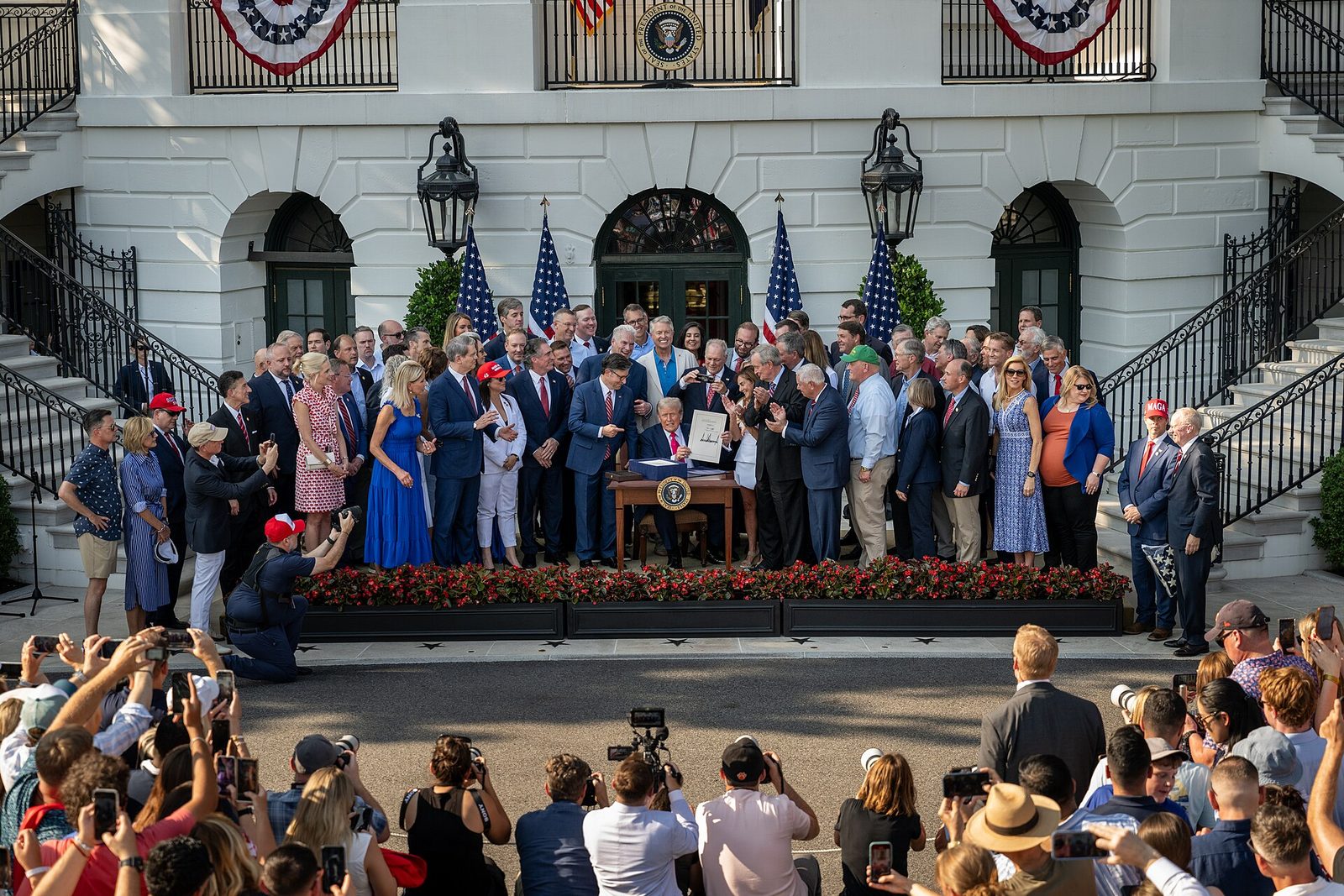
"Big Beautiful Bill": $4.5T tax cuts, +$3.4T deficit
Tax cuts weighted to top earners, paid for partly by Medicaid and SNAP cuts, adding ~$3.4T to the debt.
Key facts
- ~$4.5T in tax cuts; ~$3.4T added to the deficit ($4.1T w/ interest)
- Senate 51-50, VP Vance tiebreak; signed July 4, 2025
- Top 10% get ~80% of the value; lowest earners net worse off (PWBM)
Summary
On July 4, 2025, President Trump signed the budget-reconciliation law widely called the "One Big Beautiful Bill Act" (H.R. 1, Public Law 119-21). It makes the expiring 2017 tax cuts permanent and adds new temporary deductions - about $4.5 trillion in tax cuts over a decade - partly offset by roughly $1.4 trillion in cuts to Medicaid, SNAP, and student aid. CBO scored it as increasing the federal deficit by about $3.4 trillion through 2034 ($4.1 trillion including interest).
What happened
H.R. 1 passed the House 215-214 on May 22, 2025 and the Senate 51-50 on July 1 with Vice President Vance breaking the tie, after the parliamentarian's "Byrd bath" stripped dozens of provisions - including the bill's own "One Big Beautiful Bill Act" short title, so the enacted law (P.L. 119-21) technically has no short title. Senate Republicans used a "current-policy baseline" to score the ~$3.8 trillion tax-cut extension as costing $0; under CBO's conventional scoring the law increases deficits by ~$3.4 trillion. The law also raised the statutory debt ceiling by $5 trillion. The tax provisions took effect for tax year 2025; the offsetting Medicaid and SNAP cuts phase in through 2026-2028.
Impact on the United States
The Penn Wharton Budget Model found the top 10% of the income distribution receives about 80 percent of the law's total value, while, once the Medicaid and SNAP cuts are counted, the lowest-income households are net worse off - losing about 1.1% of income in 2027, deepening to roughly 7.4% by 2033. The ~$3.4 trillion in added deficits ($4.1 trillion with interest) raise debt-service costs borne by all taxpayers.
Documented effects
- CBO estimated the law increases the deficit by ~$3.4 trillion over 2025-2034 (conventional), composed of ~$4.5 trillion in lost revenue offset by ~$1.1 trillion in net spending cuts; ~$4.1 trillion including interest.[1]
- Permanently extending the 2017 law's lower individual income tax rates is the largest single piece (~$2.2 trillion); new temporary deductions - no tax on tips and overtime and a $6,000 senior deduction - expire after 2028, while the SALT cap rises to $40,000 through 2029 before reverting to $10,000 in 2030.[2][5]
- The Penn Wharton Budget Model projected the lowest-income quintile is net worse off after the Medicaid and SNAP cuts - about -1.1% of income in 2027, worsening to -7.4% by 2033 - while the top 10% of the income distribution receives about 80 percent of the total value.[3]
- The law raised the statutory debt limit by $5 trillion.[5]
Projected cost to Americans
Cumulative cost if current policy holds: direct federal cost plus the broader economic burden. A conservative, lower-bound estimate (medium confidence).
- So far
- $476.27B
- By 2035
- $4.49T
- By 2040
- $7.27T
How this is calculated: LAYER 1 (direct federal, REVENUE side only): this anchor books the law's net federal REVENUE LOSS from CBO's official cost estimate (revenue estimates by JCT) [S1]. Total change in revenues, FY2025-2034: -$4,485.8B, so net_cost_10yr_usd = $4,486B. That figure is already net of the law's revenue raisers, including the repeal/phase-out of the Inflation Reduction Act clean-energy credits (~$543B per BPC [S2]). CBO's window ends at FY2034; FY2035 is not added, to stay on the same window as the linked savings blocks. 15yr (through 2040): $4,486B plus six more years (FY2035-2040) at $463.3B a year, the average of CBO's FY2033 and FY2034 revenue losses ($447.7B and $478.9B) [S1], = ~$7,266B. A flat run-rate is used because the largest piece (the permanent TCJA extension) does not expire; CBO states the law increases on-budget deficits after 2034 [S1]. (The linked Medicaid and SNAP blocks extend their savings past FY2034 at CBO's 10-year average pace, and obbba-student-loan-overhaul at its FY2034 figure, so the OBBBA blocks do not yet use one extrapolation rule; see decisions.) Interest on the added debt is NOT included (BPC: over $700B through 2034 [S2]). The earlier $5.5T 15yr figure was unsourced and implied only ~$170B a year after 2034. The law's SPENDING side is booked in linked events, not here, each from the same CBO table: medicaid-aca-reconciliation-cuts (Title VII Subtitle B health outlays, -$1,058B), snap-food-assistance-cuts (Title I Subtitle A nutrition outlays, -$186.65B) and obbba-student-loan-overhaul (Title VIII, -$284.0B) as savings, and ice-detention-expansion-bbba (Title IX Subtitle A and Title X Subtitle A immigration/border outlays, +$169.9B) as a cost. Together with this anchor they sum to ~$3,127B. The ~$267B gap to CBO's total is spending CBO scored that no block books - mainly the Title II defense increase (+$149.5B) and non-SNAP agriculture/farm-program increases (~+$65.7B) - so the site understates the law's deficit effect by that amount (see decisions); nothing is double counted. Two small items from other titles are booked in their own events and are not part of that gap: kennedy-center-takeover (Title VI Sec. 60025 repair appropriation, $0.257B of CBO-scored outlays) and public-lands-fossil-fuel-expansion (the onshore royalty-rate cut, a ~$0.25B federal-share estimate from Taxpayers for Common Sense, not a CBO line). Across all titles CBO's net deficit increase is $3,394.4B [S1]. LAYER 2 = 0 here; the law's household harms are itemized in the linked events. The Republican "current-policy baseline" that scores the TCJA extension at ~$0 is a convention and is NOT used.
Why this is rated critical
The largest single fiscal action of the administration: ~$4.5T in tax cuts, with the top 10% receiving about 80% of the value (Penn Wharton Budget Model), partly offset by ~$1.4T in Medicaid/SNAP/student-aid cuts; CBO scores it as adding ~$3.4T to the deficit ($4.1T with interest). It raised the debt ceiling $5T, and PWBM projects the lowest-income households end up net worse off.
Corrections & updates [5]
Every change to a fact on this page after publication is logged here, newest first.
- CorrectedKey facts
The effect described the ~$2.2 trillion item as the whole permanent extension of the 2017 individual tax cuts; in the Bipartisan Policy Center's JCT-based table it is the lower individual income tax rates alone (seven major 2017-law extensions total ~$3.7 trillion net). It also said the $40,000 SALT cap sunsets after 2028; under section 70120 of the law the higher cap applies through 2029 and reverts to $10,000 for 2030 onward. The tips, overtime and $6,000 senior deductions do expire after 2028. The debt-limit effect was cited to CRFB, which does not mention it; the law's text raises the limit by $5,000,000,000,000 (the "$36.1T to $41.1T" levels are not in either source and are removed).[2][5]
- ClarifiedSource
Added the official roll calls for the vote counts (House 215-214 on May 22, 2025; Senate 50-50 with the Vice President voting yea on July 1, 2025). Reworded "masking", which characterized intent, to a neutral description. Relabeled the Bipartisan Policy Center, Penn Wharton Budget Model and CRFB as Tier 3 (nonpartisan analysis, not news outlets) and corrected their publication dates.[1][2][6][7]
- CorrectedUS impact
Two claims had no cited source: that the Tax Policy Center found the top 1% gain about 3.5% of after-tax income (no TPC source is cited; the Penn Wharton Budget Model table shows a 3.5% gain for the 95th-99th percentiles in 2027, not the top 1%), and that "about 16 million more Americans are projected to be uninsured by 2034" (not in any cited source). Both are removed. The effect saying "top earners capture roughly 80%" is made precise: PWBM says the top 10% of the income distribution receives about 80 percent of the total value. "Sharply regressive" is replaced with the sourced distribution figures.[1][3]
- ClarifiedSeverity rationale
The severity rationale called the tax cuts 'mostly regressive' without attribution; it now states the Penn Wharton Budget Model's distributional finding. Severity unchanged.
+ Show previous and current text- Hide previous and current text
- Previously
- The largest single fiscal action of the administration: ~$4.5T in mostly regressive tax cuts, partly paid for by ~$1.4T in Medicaid/SNAP/student-loan cuts, adding ~$3.4T to the deficit ($4.1T with interest) and raising the debt ceiling $5T - while leaving the lowest-income Americans net worse off.
- Now
- The largest single fiscal action of the administration: ~$4.5T in tax cuts, with the top 10% receiving about 80% of the value (Penn Wharton Budget Model), partly offset by ~$1.4T in Medicaid/SNAP/student-aid cuts; CBO scores it as adding ~$3.4T to the deficit ($4.1T with interest). It raised the debt ceiling $5T, and PWBM projects the lowest-income households end up net worse off.
- CorrectedCost estimate
The booked-so-far figure (~$300B) had no source; it now uses CBO's official estimate of the law's revenue loss for FY2025 plus three quarters of FY2026, through mid-2026 ($130.9B + 0.75 x $460.5B). The 10-year figure now uses CBO's exact total ($4,485.8B). The 2040 projection was unsourced and implied the permanent tax cuts would cost only ~$170B a year after 2034; it now extends CBO's FY2033-34 revenue loss (~$463B a year) through 2040.
- Previously
- $300B booked; $4.5T by 2035; $5.5T by 2040
- Now
- $476.3B booked; $4.49T by 2035; $7.27T by 2040
Sources [7]
- T1Congressional Budget Office - Estimated Budgetary Effects of H.R. 1, the One Big Beautiful Bill Act (Public Law 119-21) · Jul 21, 2025 ↗
- T3Bipartisan Policy Center - What Does the One Big Beautiful Bill Cost? · Jul 23, 2025 ↗
- T3Penn Wharton Budget Model - President Trump Signed the Reconciliation Bill into Law: Budgetary, Economic, and Distributional Effects · Jul 8, 2025 ↗
- T3Committee for a Responsible Federal Budget - What's In the One Big Beautiful Bill Act? · Jul 22, 2025 ↗
- T1U.S. Government Publishing Office - Public Law 119-21 (H.R. 1), 139 Stat. 72, enacted July 4, 2025 · Jul 4, 2025 ↗
- T1Office of the Clerk, U.S. House of Representatives - Roll Call 145: H.R. 1, On Passage (May 22, 2025) · May 22, 2025 ↗
- T1U.S. Senate - Roll Call Vote 119th Congress - 1st Session, Vote Number 372: On Passage of the Bill (H.R. 1, as Amended) · Jul 1, 2025 ↗
Image: The White House (Molly Riley), Public domain (Wikimedia Commons)