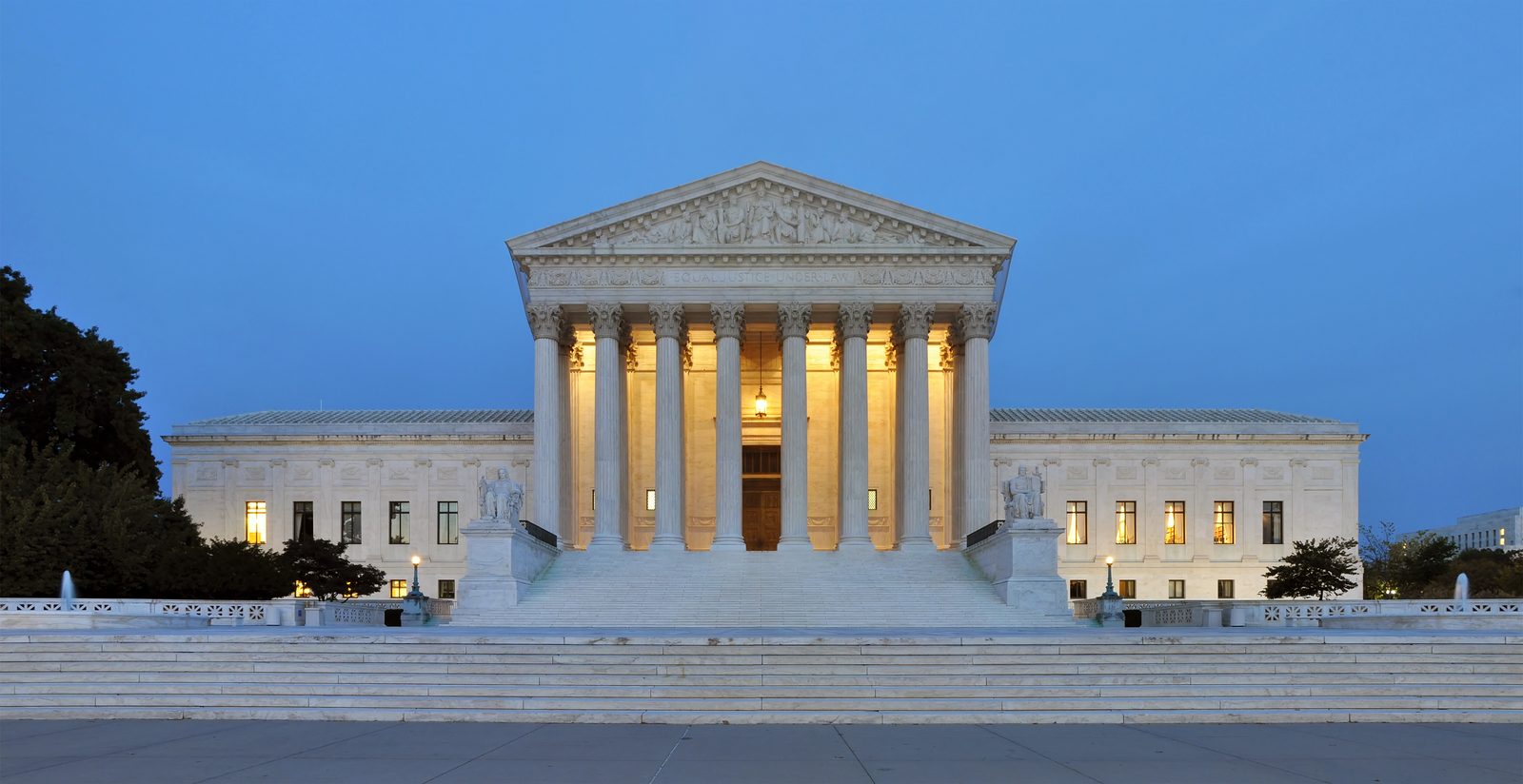
Supreme Court rules against birthright-citizenship order
An order denying citizenship to US-born children whose parents are neither citizens nor permanent residents was blocked within days.
Key facts
- Blocked Jan 23, 2025 as 'blatantly unconstitutional'
- 22 states sued
- Supreme Court ruled 6-3 against the order June 30, 2026
Summary
President Trump signed EO 14160 ("Protecting the Meaning and Value of American Citizenship") on January 20, 2025, directing agencies to deny birthright citizenship to children born in the US to parents who are undocumented or present on temporary visas. Federal courts blocked the order within days, and on June 30, 2026 the Supreme Court ruled 6-3 against it: a five-justice majority held that it violates the Fourteenth Amendment, and Justice Kavanaugh agreed with the result on statutory grounds only.
What happened
EO 14160 directed agencies to deny citizenship documents to children born on US soil when neither parent is a US citizen or lawful permanent resident. Judge John C. Coughenour (W.D. Wash.) issued a nationwide temporary restraining order on January 23, 2025, calling it "a blatantly unconstitutional order." Multiple district courts in Washington, Maryland, and Massachusetts issued preliminary injunctions through mid-2025. The Supreme Court accepted the case (Trump v. Barbara, No. 25-365) on December 5, 2025, heard oral arguments on April 1, 2026, and decided the case on June 30, 2026, affirming 6-3 a New Hampshire federal court's class-wide preliminary injunction. Chief Justice Roberts, joined by Justices Sotomayor, Kagan, Barrett and Jackson, held that children born in the US to parents unlawfully or temporarily present are "subject to the jurisdiction" of the United States and are citizens at birth under the Fourteenth Amendment's Citizenship Clause. Justice Kavanaugh concurred in the judgment and dissented in part: in his view the order does not violate the Fourteenth Amendment but does contravene the federal citizenship statute, 8 U.S.C. 1401(a), which Congress could amend. Justice Thomas (joined by Justice Gorsuch), Justice Alito and Justice Gorsuch dissented.
Impact on the United States
Directly threatens citizenship status for an estimated hundreds of thousands of US-born children annually if the order were to take effect. Creates legal uncertainty for affected families, US hospitals, and vital-records offices required to issue birth certificates. Destabilizes the 14th Amendment's citizenship guarantee upheld in United States v. Wong Kim Ark (1898).
Documented effects
- Injunctions from federal district courts (universal injunctions in Maryland, Washington and Massachusetts in February 2025, then a nationwide class-wide injunction in New Hampshire in July 2025) kept the order from ever taking effect.[7][8]
- Supreme Court accepted the case December 5, 2025 for its 2025-26 term; oral arguments held April 1, 2026.[2]
- Supreme Court ruled 6-3 against the order in Trump v. Barbara (June 30, 2026): a five-justice majority held that children born in the US to parents unlawfully or temporarily present are citizens at birth under the Fourteenth Amendment; Justice Kavanaugh concurred in the judgment on statutory grounds only, and Justices Thomas, Alito and Gorsuch dissented.[3][4]
- In August 2026 the President signed a new order denying citizenship to narrower categories of US-born children (including children of 'alien enemies' and of foreign government employees); U.S. District Judge Deborah Boardman blocked it for a certified class on September 2, 2026, finding the plaintiffs likely to succeed under the Fourteenth Amendment (see the separate entry on the 2026 orders).[5]
Why this is rated limited
Sought to deny citizenship to US-born children of parents who are neither citizens nor permanent residents but was blocked in courts within days and never took effect; the Supreme Court ruled against it 6-3 on June 30, 2026, so realized harm is minimal.
Supreme Court ruled 6-3 against the order in Trump v. Barbara on June 30, 2026
Corrections & updates [10]
Every change to a fact on this page after publication is logged here, newest first.
- UpdatedStatus
Updated: on June 30, 2026 the Supreme Court ruled 6-3 against the order in Trump v. Barbara, affirming a class-wide injunction. Chief Justice Roberts and Justices Sotomayor, Kagan, Barrett and Jackson held that the order violates the Fourteenth Amendment's Citizenship Clause; Justice Kavanaugh concurred in the judgment on statutory grounds only (8 U.S.C. 1401(a)); Justices Thomas, Alito and Gorsuch dissented.[3][4]
- UpdatedKey facts
Updated: in August 2026 the President signed a new order narrowing birthright citizenship, and on September 2, 2026 a federal judge blocked it for a certified class. That order is covered in its own entry.[5]
- CorrectedSource
Corrected: Lawfare is a legal-analysis publication, not a news wire, so its source label was changed from Tier 2 to Tier 3. The Supreme Court's opinion (Tier 1) now anchors this entry.[3]
- CorrectedKey facts
The entry said 19 states sued. Twenty-two states sued on January 21, 2025: 18 states plus the District of Columbia and San Francisco in Massachusetts, and Washington, Arizona, Illinois and Oregon in Seattle.[1][6]
- Previously
- 19 states sued
- Now
- 22 states sued
- CorrectedEffects
The entry credited "nationwide injunctions from four federal district courts" as of June 2026 to a January 2025 article, which cannot support that. Per SCOTUSblog, district courts in Maryland, Washington and Massachusetts issued universal injunctions in February 2025, and a New Hampshire court issued a nationwide class-wide injunction on July 10, 2025; the Supreme Court later affirmed that injunction. NPR reports the order never went into effect.[7][8]
- ClarifiedSource
Source tiers relabeled. SCOTUSblog is a specialist legal outlet (Tier 3), not a major news or wire service (Tier 2).[2][4]
- ClarifiedSource
The Supreme Court revised the Trump v. Barbara slip opinion on July 1, 2026; the link now points to the revised opinion the Court lists.[3]
- ClarifiedSeverity rationale
Replaced 'strip' with 'deny', matching the order's terms. Severity unchanged.
+ Show previous and current text- Hide previous and current text
- Previously
- Sought to strip citizenship from US-born children but was blocked in courts within days and never took effect; the Supreme Court ruled against it 6-3 on June 30, 2026, so realized harm is minimal.
- Now
- Sought to deny citizenship to US-born children of parents who are neither citizens nor permanent residents but was blocked in courts within days and never took effect; the Supreme Court ruled against it 6-3 on June 30, 2026, so realized harm is minimal.
- CorrectedDisplay copy
The display text described the order as covering children of 'undocumented' or 'non-citizen' parents. The order covered children when neither parent is a US citizen or permanent resident (including parents on temporary visas); the text now matches.[3]
- CorrectedCost estimate
The $18M litigation-cost figure and the $7M residual were estimates with no source and are removed; government litigation costs are not published. The basis is also updated: the Supreme Court ruled 6-3 against the order on June 30, 2026, and 22 states (not 19) sued.
- Previously
- net $18M so far; 10yr $25M; 15yr $25M
- Now
- net $0; 10yr $0; 15yr $0
Sources [8]
- T3Lawfare Media - Federal Judge Blocks Trump's Birthright Executive Order Nationwide · Jan 23, 2025 ↗
- T3SCOTUSblog - Supreme Court agrees to hear Trump's challenge to birthright citizenship · Dec 5, 2025 ↗
- T1Supreme Court of the United States - Trump v. Barbara, No. 25-365 (slip opinion) · Jun 30, 2026 ↗
- T3SCOTUSblog - Supreme Court strikes down Trump's order ending birthright citizenship · Jun 30, 2026 ↗
- T2CBS News - Judge blocks Trump's latest effort to narrow birthright citizenship · Sep 3, 2026 ↗
- T2PBS NewsHour (Associated Press) - 22 states sue to stop Trump's block on birthright citizenship · Jan 21, 2025 ↗
- T3SCOTUSblog - Where does Trump's birthright citizenship order currently stand? · Jul 18, 2025 ↗
- T2NPR - Supreme Court upholds birthright citizenship on constitutional grounds · Jun 30, 2026 ↗
Image: Joe Ravi, CC BY-SA 3.0 (Wikimedia Commons)