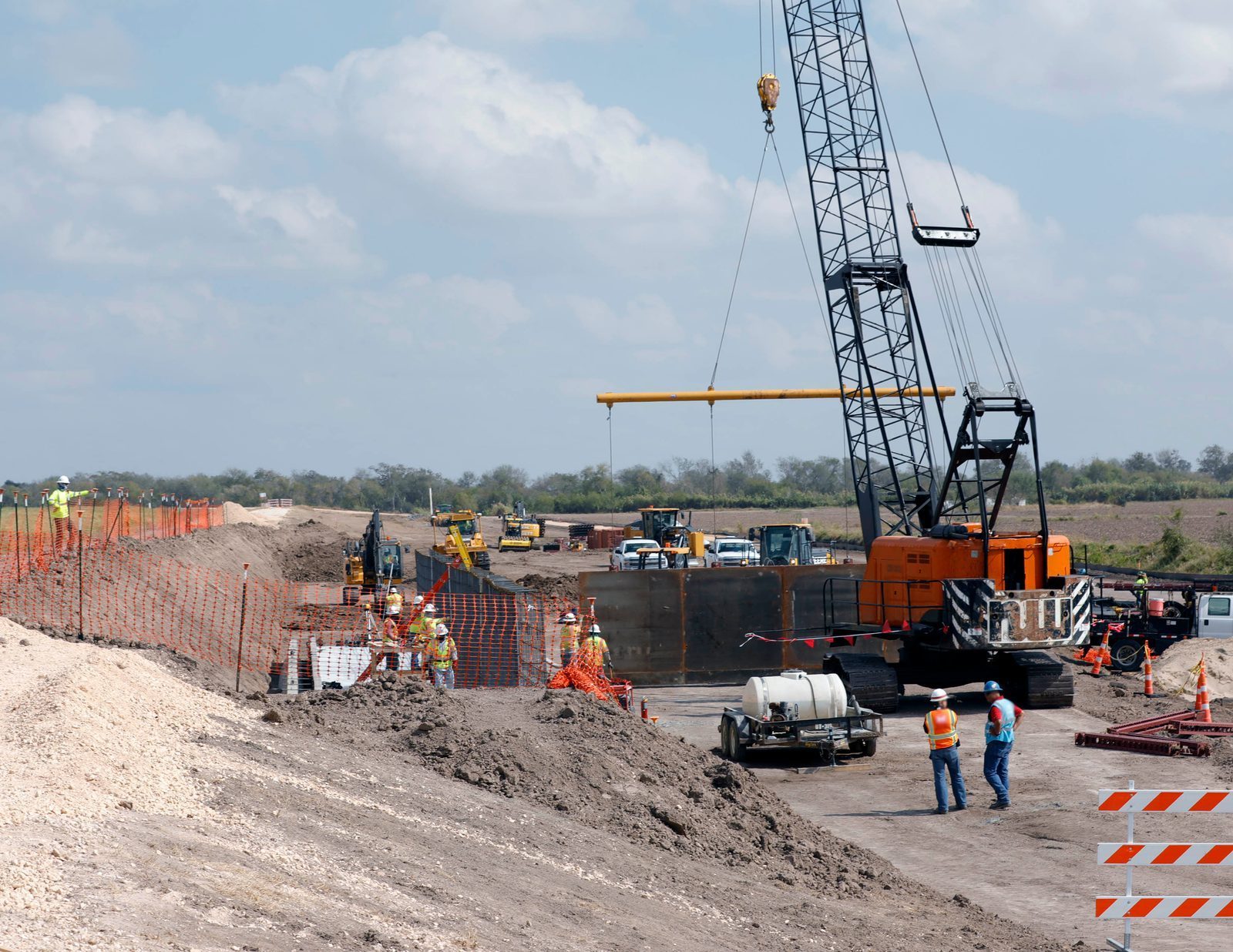
Military takes control of 800+ miles of border
National Defense Areas placed border territory under Pentagon control, enabling civilian arrests.
Key facts
- 800+ miles of border land in military zones by March 2026
- 8,500-10,000 troops deployed
- 4,700+ migrants charged with military trespass
Summary
On April 11, 2025, Trump issued a National Security Presidential Memorandum directing the Pentagon to take jurisdiction over federal lands along the US-Mexico border, creating "National Defense Areas" (NDAs) where active-duty troops can detain and arrest border crossers. By March 2026, six National Defense Areas in all four border states covered more than 800 miles, about 42% of the border, according to The War Horse.
What happened
The memorandum designated strips of federal land - including the historic Roosevelt Reservation across California, Arizona, and New Mexico - as National Defense Areas under DoD control. Active-duty troops (peaking at approximately 8,500-10,000) were authorized to patrol and detain border crossers in these areas, who could then be charged by federal prosecutors with trespassing on military property (18 U.S.C. § 1382). By April 2026, approximately 4,700 immigrants had faced these criminal trespass charges, but federal magistrate judges in New Mexico and Texas dismissed or dropped the majority of resolved cases, repeatedly ruling the government could not prove the migrants knew they were entering a military zone. The Air Force announced the designation of an additional 250-mile serpentine stretch of Texas border in June 2025.
Impact on the United States
The Brennan Center and legal experts concluded the arrangement appears designed to evade the Posse Comitatus Act (1878), which prohibits using federal armed forces for domestic law enforcement. Using military assets for civilian law enforcement duties sets a precedent for expanded executive power and blurs the civil-military divide.
Documented effects
- By March 2026 the Pentagon had established six National Defense Areas in all four border states covering more than 800 miles, about 42% of the US-Mexico border (The War Horse); more than 10,000 troops were deployed by summer 2025 and about 8,500 in February 2026.[1][5][6]
- Approximately 4,700 migrants charged with military trespass by April 2026; the majority of resolved cases were dismissed or dropped after magistrate judges found no proof the migrants knew they were entering a military zone.[2][3]
- Brennan Center analysis found the policy likely violates the Posse Comitatus Act by deploying troops in a de facto domestic law enforcement role.[2]
- A Justice Department legal opinion concluded that military personnel can arrest people who leave National Defense Areas before they can be apprehended for trespassing without violating the Posse Comitatus Act; about 8,000 service members were deployed, and troops had made 161 temporary detentions in six NDAs.[4]
- In February 2026 the Air Force established a new 150-mile Del Rio-Falcon National Defense Area and extended the 250-mile South Texas area by 40 miles; about 8,500 troops were then deployed under the task force.[6]
Projected cost to Americans
Cumulative cost if current policy holds: direct federal cost plus the broader economic burden. A conservative, lower-bound estimate (low confidence).
- So far
- $376M
- By 2035
- $376M
- By 2040
- $376M
How this is calculated: Layer-1 = DoD operational cost of the southern-border military mission (Joint Task Force-Southern Border, including the National Defense Areas). The only published cost is the Pentagon's ~$376M from Jan 20 to ~Apr 1, 2025 (~70 days) [S1], so booked = 10yr = 15yr = $376M, a floor. The mission continued and grew (troop levels rose from ~6,700 in April 2025 to ~8,000-8,500 in 2026), but no later cost has been published, and holding the early daily rate (~$5.4M) flat for the rest of the term would be an assumption: early-phase deployment costs may be front-loaded while troop levels rose, so the direction of error is unknown. For reference only, that flat rate would give ~$2.8B through June 2026 and ~$7.9B through January 2029; neither is booked. The earlier $9B/$11B assumed an unsourced half-strength drawdown. Layer 2 set to 0 - this is a direct federal/DoD outlay, not a distinct macroeconomic loss to the public.
Why this is rated significant
Placed more than 800 miles of border land under military jurisdiction, an arrangement the Brennan Center said likely violates the Posse Comitatus Act; a significant precedent, though most resolved trespass cases were dismissed or dropped.
Corrections & updates [7]
Every change to a fact on this page after publication is logged here, newest first.
- UpdatedKey facts
Updated: an August 2026 Justice Department legal opinion concluded troops may arrest people who leave National Defense Areas before they can be apprehended for trespassing.[4]
- CorrectedSource
Corrected: the Brennan Center for Justice is a policy institute, not a news outlet, so its source label was changed from Tier 2 to Tier 3.
- ClarifiedSummary
Troops do not bring the trespass charges; federal prosecutors do. The Pentagon said as of mid-March 2026 that troops had arrested only 68 people in these areas (Tucson Sentinel / The War Horse). CBS News reported 161 temporary detentions by August 2026.[4][5]
+ Show previous and current text- Hide previous and current text
- Previously
- The memorandum designated strips of federal land - including the historic Roosevelt Reservation across California, Arizona, and New Mexico - as National Defense Areas under DoD control. Active-duty troops (peaking at approximately 8,500-10,000) were authorized to patrol, detain, and charge border crossers with trespassing on military property (18 U.S.C. § 1382). By April 2026, approximately 4,700 immigrants had faced these criminal trespass charges, but federal magistrate judges in New Mexico and Texas dismissed or dropped the majority of resolved cases, repeatedly ruling the government could not prove the migrants knew they were entering a military zone. The Air Force announced annexation of an additional 250-mile serpentine stretch of Texas border in June 2025.
- Now
- The memorandum designated strips of federal land - including the historic Roosevelt Reservation across California, Arizona, and New Mexico - as National Defense Areas under DoD control. Active-duty troops (peaking at approximately 8,500-10,000) were authorized to patrol and detain border crossers in these areas, who could then be charged by federal prosecutors with trespassing on military property (18 U.S.C. § 1382). By April 2026, approximately 4,700 immigrants had faced these criminal trespass charges, but federal magistrate judges in New Mexico and Texas dismissed or dropped the majority of resolved cases, repeatedly ruling the government could not prove the migrants knew they were entering a military zone. The Air Force announced annexation of an additional 250-mile serpentine stretch of Texas border in June 2025.
- CorrectedSource
The troop figures were cited only to an NPR article that does not contain them. The War Horse reports more than 10,000 troops by summer 2025 and about 9,000 in March 2026; Stars and Stripes reported about 8,500 in February 2026. In February 2026 the Air Force also established a 150-mile Del Rio-Falcon National Defense Area and extended the 250-mile South Texas area by 40 miles.[5][6]
- CorrectedFigure
No cited source supports 'over 600 miles' transferred by mid-2025. The War Horse (via Tucson Sentinel) reports that by March 2026 six National Defense Areas in all four border states covered more than 800 miles, about 42% of the border. 'Occupation' and 'annexation' replaced with neutral wording; troops detain crossers, and prosecutors (not troops) bring trespass charges.[5][6][1][2]
- ClarifiedSeverity rationale
Attributed the Posse Comitatus concern to the Brennan Center. Severity unchanged.
+ Show previous and current text- Hide previous and current text
- Previously
- Placed more than 800 miles of border land under military control, risking Posse Comitatus violations, a significant precedent though trespass charges were largely dismissed.
- Now
- Placed more than 800 miles of border land under military jurisdiction, an arrangement the Brennan Center said likely violates the Posse Comitatus Act; a significant precedent, though most resolved trespass cases were dismissed or dropped.
- CorrectedCost estimate
Cut to the Pentagon's only published figure for the border military mission: about $376M for its first ~70 days (Stars and Stripes). The old $2.1B multiplied that early daily rate by the wrong number of days and added unsourced items, and the 10- and 15-year figures assumed an unsourced drawdown. The mission has continued, but no later cost has been published, so $376M is a floor.
- Previously
- net $2.1B so far; 10yr $9B; 15yr $11B
- Now
- net $376M so far; 10yr $376M; 15yr $376M
Sources [6]
- T2NPR - Trump expands military use at the southern border. Are there legal limits? · May 6, 2025 ↗
- T3Brennan Center for Justice - How Turning the Border into a Military Zone Evades Congress and Threatens Rights · Apr 28, 2025 ↗
- T2KJZZ - Nearly 5,000 migrants were charged with military trespassing at border. Most cases got dropped · Apr 7, 2026 ↗
- T2CBS News - Justice Department expands military's power to detain migrants accused of trespassing · Aug 15, 2026 ↗
- T3Tucson Sentinel (The War Horse / The Border Chronicle) - A war zone, minus the war: One year later, has the military really secured the U.S.-Mexico border? · Mar 28, 2026 ↗
- T2Stars and Stripes - Air Force establishing new military zone, expanding existing one in Texas · Feb 10, 2026 ↗
Image: CBP Photography / U.S. Customs and Border Protection, Public domain (Wikimedia Commons)