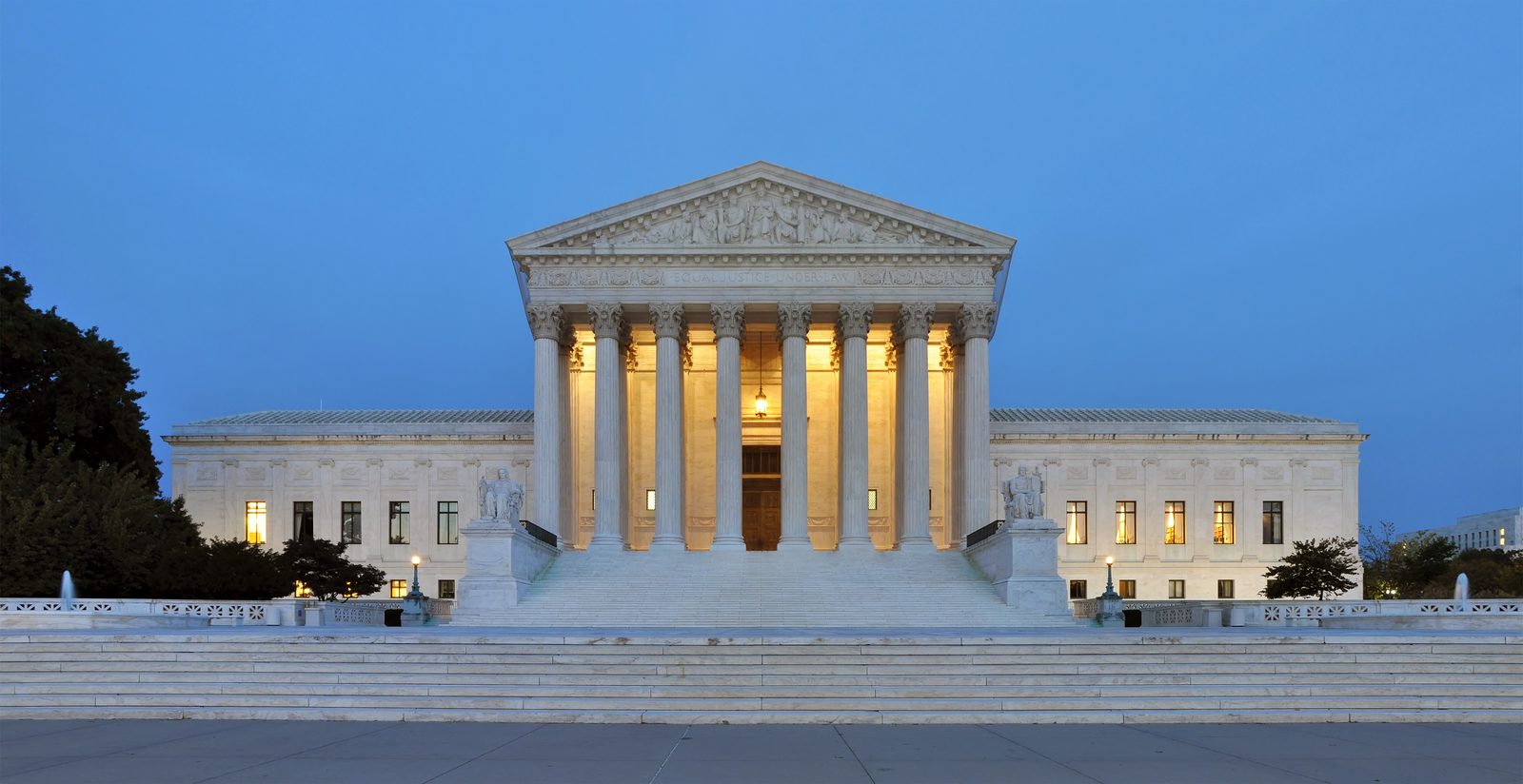
Supreme Court strikes down IEEPA tariffs
Court ruled tariffs are reserved to Congress, invalidating the basis for most 2025 tariffs.
Key facts
- Supreme Court ruled 6-3 Feb 20, 2026
- ~$166B in IEEPA tariffs collected; about $100B certified for refund to importers by early August 2026
- Section 122 replacement also struck down (CIT, May 7, 2026); collected under a Federal Circuit stay until it expired July 24, 2026
Summary
The U.S. Supreme Court ruled 6-3 on February 20, 2026, that the International Emergency Economic Powers Act does not grant the President authority to impose tariffs. The ruling affirmed lower court decisions and terminated most of the Trump administration's 2025 tariff regime. IEEPA-based tariffs expired at midnight on February 24, 2026. The Section 122 tariffs imposed to replace them were themselves struck down by the Court of International Trade on May 7, 2026, but a Federal Circuit stay kept them in collection until they expired on July 24, 2026.
What happened
The Court held that IEEPA's authority to "regulate . . . importation" does not authorize the President to impose tariffs, reasoning that the power to regulate does not include the power to tax, which Congress grants separately and expressly. The Federal Circuit had characterized the tariffs as "unbounded in scope, amount, and duration" in August 2025. Within hours of the ruling, Trump announced a replacement 10% global tariff under Section 122 of the Trade Act of 1974 (which is capped at 15% and expires after 150 days by statute). On May 7, 2026, the Court of International Trade ruled 2-1 that the Section 122 tariffs also exceeded presidential authority; the government appealed, the Federal Circuit issued an administrative stay May 12, 2026 and granted a stay pending appeal June 11, 2026, staying the CIT's injunction, which had covered only the three named plaintiffs, so the Section 122 duty remained in collection until it expired on July 24, 2026. Approximately $166 billion in tariff revenue collected under IEEPA is potentially subject to refund; CBP has since deployed Phase 1 of its CAPE refund functionality within ACE and begun processing IEEPA refund claims in spring 2026.
Impact on the United States
Importers who paid IEEPA duties since February 2025 face potential refund claims, creating accounting and legal uncertainty for businesses; CBP began an operational refund process in spring 2026, though full refunds are ongoing. The federal budget, which collected $264 billion in customs duties in 2025 (vs. $79 billion in 2024), faces potential refund liabilities. The Section 122 replacement tariffs were struck down by the CIT (May 7, 2026) but remained in collection under a Federal Circuit stay pending appeal until their statutory expiration on July 24, 2026.
Global ripple effects
The ruling and rapid replacement with Section 122 tariffs continued to affect trading partners' retaliatory postures and ongoing trade negotiations.
Documented effects
- The Supreme Court ruled 6-3 that IEEPA does not authorize tariffs; IEEPA tariffs terminated February 24, 2026.[1]
- Approximately $166 billion was collected under the IEEPA tariffs (per Customs and Border Protection court disclosures); the Penn Wharton Budget Model estimated up to roughly $175 billion in potential refunds with interest. CBP deployed Phase 1 of its CAPE refund functionality within ACE and began processing IEEPA refund claims in spring 2026.[2][4]
- Trump imposed a 10% global Section 122 tariff as a replacement effective February 24, 2026, with a statutory 150-day expiration (July 23-24, 2026).[1]
- The Court of International Trade struck down the Section 122 replacement tariffs 2-1 on May 7, 2026 as exceeding presidential authority; the Federal Circuit issued an administrative stay (May 12) and a stay pending appeal (June 11, 2026), staying the CIT's injunction (which had covered only the three named plaintiffs), so the 10% Section 122 duty remained in collection until it expired on July 24, 2026.[3][5]
- The 10% Section 122 surcharge expired July 24, 2026 at the end of its 150-day statutory period and was replaced with new Section 301 tariffs.[6][7]
- CBP told the Court of International Trade on Aug. 4, 2026 that nearly $129 billion in potential and certified refunds had been accepted for processing and about $100 billion had been certified and sent to Treasury for payment, about 60% of the roughly $166 billion collected.[9]
- The government appealed the Court of International Trade's refund order, arguing in its Federal Circuit brief that refunding duties to non-party importers "cannot possibly be squared with" Trump v. CASA; refunds for more complex entries remain on hold.[11]
- A Sept. 15, 2026 CBP court declaration put refunds certified and sent to Treasury at about $122 billion, including interest, as of Sept. 11. Refunds go to the importers of record, not to consumers who paid higher prices.[10]
Projected cost to Americans
Cumulative cost if current policy holds: direct federal cost plus the broader economic burden. A conservative, lower-bound estimate (medium confidence).
- So far
- $39.00B
- By 2035
- $100.00B
- By 2040
- $100.00B
How this is calculated: NUMBERS UNCHANGED; basis refreshed with the Aug-Sept 2026 refund data. CBP reported ~$100B completed, certified and sent to Treasury for disbursement in its Aug 4, 2026 court filing (data as of July 31) [S1]; the Conference Board describes that ~$100B as including interest [S4]. CBP reported ~$122B, including interest, certified and sent to Treasury as of Sept 11, 2026 (Sept 15 declaration) [S2][S3]. About $134.7B in potential and certified refunds had been accepted into CAPE, and CAPE Phase 3 (finally liquidated entries covered by court-ordered reliquidation) opens Oct 6, 2026 [S3]. Faster payment reduces future interest on the outstanding balance, which lowers Layer 1. But the government is appealing the CIT's refund order to the Federal Circuit, arguing under Trump v. CASA that refunds to non-party importers are a barred universal injunction [S4]. That leaves the outcome for the harder entries unresolved. Judging the two effects roughly offsetting, the ~$60B Layer-1 residual (interest, admin and the contested share) is held; this is a judgment, not a new calculation. Layer 2 (~$40B business disruption) is also unchanged. The ~$28.2B in direct Section 122 duties Tax Foundation projects for Feb 24 - Jul 24, 2026 [S5] is NOT a refund liability unless the CIT's May 7, 2026 Section 122 ruling is upheld on appeal; it is not booked here.
Why this is rated severe
The ruling invalidated $166B in collected tariffs, creating major refund and budget uncertainty; harm is the disruption from a year of unlawful tariffs now unwound.
IEEPA tariffs terminated February 24, 2026; the Section 122 replacement, struck down by the CIT May 7, 2026 but kept in collection under a Federal Circuit stay, expired July 24, 2026
Corrections & updates [6]
Every change to a fact on this page after publication is logged here, newest first.
- UpdatedStatus
The 10% Section 122 surcharge ran for its 150-day statutory period and expired on July 24, 2026, under Proclamation 11012. The Yale Budget Lab reports it was replaced with new tariffs under Section 301. It had been in collection under a Federal Circuit stay pending appeal.[6][7]
- ClarifiedSummary
Restated the holding as the Court gave it: IEEPA's authority to "regulate . . . importation" does not include the power to impose tariffs (a statutory holding, per the Congressional Research Service), rather than a ruling that the taxing power "cannot be delegated".[1]
+ Show previous and current text- Hide previous and current text
- Previously
- The Court held that tariffs constitute a branch of the taxing power reserved to Congress under Article I and cannot be delegated via IEEPA. The Federal Circuit had characterized the tariffs as "unbounded in scope, amount, and duration" in August 2025. Within hours of the ruling, Trump announced a replacement 10% global tariff under Section 122 of the Trade Act of 1974 (which is capped at 15% and expires after 150 days by statute). On May 7, 2026, the Court of International Trade ruled 2-1 that the Section 122 tariffs also exceeded presidential authority; the government appealed, the Federal Circuit issued an administrative stay May 12, 2026 and granted a stay pending appeal June 11, 2026, so the Section 122 duty continued to be collected from all importers except the three named plaintiffs until it expired on July 24, 2026. Approximately $166 billion in tariff revenue collected under IEEPA is potentially subject to refund; CBP has since deployed Phase 1 of its CAPE refund functionality within ACE and begun processing IEEPA refund claims in spring 2026.
- Now
- The Court held that IEEPA's authority to "regulate . . . importation" does not authorize the President to impose tariffs, reasoning that the power to regulate does not include the power to tax, which Congress grants separately and expressly. The Federal Circuit had characterized the tariffs as "unbounded in scope, amount, and duration" in August 2025. Within hours of the ruling, Trump announced a replacement 10% global tariff under Section 122 of the Trade Act of 1974 (which is capped at 15% and expires after 150 days by statute). On May 7, 2026, the Court of International Trade ruled 2-1 that the Section 122 tariffs also exceeded presidential authority; the government appealed, the Federal Circuit issued an administrative stay May 12, 2026 and granted a stay pending appeal June 11, 2026, so the Section 122 duty continued to be collected from all importers except the three named plaintiffs until it expired on July 24, 2026. Approximately $166 billion in tariff revenue collected under IEEPA is potentially subject to refund; CBP has since deployed Phase 1 of its CAPE refund functionality within ACE and begun processing IEEPA refund claims in spring 2026.
- ClarifiedSource
Tier labels corrected: Skadden and Greenberg Traurig client alerts and the Mallory Group blog are specialist analyses (Tier 3), not major news outlets. The CRS Legal Sidebar is dated February 23, 2026 and the Mallory Group post June 16, 2026.[1][3][4][5]
- UpdatedKey facts
Updated: two passages still said the Section 122 replacement tariff "continues to be collected". It expired on July 24, 2026 (Federal Register; CBS News), and those passages now use the past tense.[6][8]
- UpdatedKey facts
Updated with refund progress: in an Aug. 4, 2026 court filing CBP said nearly $129 billion in potential and certified refunds had been accepted for processing and about $100 billion had been certified and sent to Treasury, about 60% of the roughly $166 billion collected (CNBC). A Sept. 15 CBP declaration put the certified total at about $122 billion, including interest, as of Sept. 11 (The Center Square). The government has appealed the court-ordered refund process to the Federal Circuit (The Conference Board).[9][10][11]
- Previously
- ~$166B in IEEPA tariff revenue potentially refundable; CBP began processing refunds in spring 2026
- Now
- ~$166B in IEEPA tariffs collected; about $100B certified for refund to importers by early August 2026
- ClarifiedSummary
The entry said the Section 122 duty kept being collected "from all importers except the three named plaintiffs" until it expired. The CIT's injunction covered only those three plaintiffs, and on June 11, 2026 the Federal Circuit stayed that injunction pending appeal. The wording now says only that the duty remained in collection until it expired on July 24, 2026.[3][5]
Sources [11]
- T1Congress.gov / Congressional Research Service - Supreme Court Rules Against Tariffs Imposed Under the International Emergency Economic Powers Act (IEEPA) · Feb 23, 2026 ↗
- T3Penn Wharton Budget Model - Supreme Court Tariff Ruling: IEEPA Revenue and Potential Refunds · Feb 20, 2026 ↗
- T3Skadden - US Trade Court Strikes Down Section 122 Tariffs · May 7, 2026 ↗
- T3Greenberg Traurig - US Tariff Update: Section 122 Duties Found Unauthorized by Law; IEEPA Refunds Under Way · May 1, 2026 ↗
- T3The Mallory Group - Section 122 Tariffs Hold: Inside the Federal Circuit's Stay and What It Means for Importers · Jun 16, 2026 ↗
- T1Federal Register - Imposing a Temporary Import Surcharge To Address Fundamental International Payments Problems (Proclamation 11012) · Feb 25, 2026 ↗
- T3Yale Budget Lab - The State of U.S. Tariffs (updated August 24, 2026) · Aug 24, 2026 ↗
- T2CBS News - Here are the new tariff rates on dozens of countries targeted by President Trump · Jul 24, 2026 ↗
- T2CNBC - Trump admin refunds $100 billion in 'liberation day' tariffs · Aug 5, 2026 ↗
- T3The Center Square (via Yahoo News) - Senators seek consumer refund plan as $122B cleared for importers · Sep 23, 2026 ↗
- T3The Conference Board - Policy Backgrounder: Tariff Refunds Update · Aug 2026 ↗
Image: Joe Ravi, CC BY-SA 3.0 (Wikimedia Commons)