Months-long US war with Iran shuts the Strait of Hormuz
A war of more than three months and a 66-day naval blockade choked Hormuz shipping; a Harvard expert says it will cost over $1 trillion all-in.
Key facts
- 66-day US naval blockade; 50,000+ troops; at least 13 US killed by mid-May
- Pentagon IG: $33.4B direct cost through June 30; Harvard's Bilmes says >$1 trillion all-in
- J.P. Morgan warned gas could top $5/gal and put the consumer hit at ~$100B if sustained
Summary
A standoff over Iran's nuclear program reignited into open war on February 28, 2026, when US and Israeli forces began striking Iran (Operation Epic Fury); Iran's attacks on commercial shipping then sharply cut traffic through the Strait of Hormuz. After talks in Islamabad collapsed, Trump ordered a full naval blockade of Iran on April 13, 2026. More than 50,000 US troops were stationed in the region, at least 42 US aircraft were damaged or destroyed, and at least 13 US service members had been killed by mid-May. The disruption of Hormuz shipping sent Brent crude to about $118 a barrel, and J.P. Morgan analysts warned gasoline could top $5 a gallon, before a ceasefire on June 14.
What happened
The 2026 war opened on February 28 when US and Israeli forces began striking targets in Iran - the US operation was Operation Epic Fury and Israel's parallel campaign Operation Roaring Lion - and Israeli strikes killed Supreme Leader Ali Khamenei. Iran responded with attacks on commercial shipping that sharply reduced traffic through the Strait of Hormuz. A two-week ceasefire agreed April 7 was extended indefinitely on April 21. Diplomatic talks in Islamabad collapsed on April 11-12, and on April 13 Trump ordered the US Navy to blockade all vessels entering or leaving Iranian ports, and CRS reports the blockade kept around 20 Navy vessels deployed for months, turning away hundreds of commercial ships and "disabling" around 10. More than 50,000 US troops were stationed in the region - the largest US military buildup in the Middle East since the 2003 invasion of Iraq, according to MSNBC. At least 13 US service members had been killed by mid-May, and the Congressional Research Service counted at least 42 US aircraft damaged or destroyed; by September 15, 2026, including the fighting after the ceasefire collapsed, CRS counted 18 US service members killed and 824 wounded. A ceasefire was announced June 14; the 66-day blockade was lifted June 18.
Impact on the United States
The Pentagon told Congress the war cost about $29 billion through mid-May, and its inspector general later put the cost from Feb. 28 to June 30 at $33.4 billion, $22.3 billion of it munitions; Harvard's Linda Bilmes, of the Costs of War project, says she is certain the all-in cost to taxpayers - munitions and aircraft replacement plus decades of care for the wounded - will exceed $1 trillion. The Hormuz disruption drove Brent crude to about $118 a barrel, and J.P. Morgan analysts warned gasoline could top $5 a gallon; J.P. Morgan economists estimated the gasoline-price increase, if it persisted for the rest of 2026, would be about a $100 billion hit to consumers' purchasing power. At least 13 US service members had been killed by mid-May; CRS counted 18 killed and 824 wounded as of September 15, 2026, including the resumed fighting. War-powers challenges followed: CRS reports the House approved three of six concurrent resolutions directing the removal of US forces from hostilities with Iran (June 3, July 23, Sept. 15) and the Senate approved one of 11 joint resolutions (May 19).
Global ripple effects
The war grew out of the unresolved standoff after the June 2025 US strikes on Iran's nuclear sites (see iran-nuclear-strikes); CRS reports the IAEA has not been able to conduct safeguards at the facilities struck in 2025. Iranian attacks hit military bases in Gulf states where US forces were present, US diplomatic facilities and energy infrastructure, and the disruption of the Strait of Hormuz caused large disruptions to global markets for oil, natural gas and other commodities (CRS).
Documented effects
- US imposes a 66-day naval blockade of Iran (Apr 13 - Jun 18, 2026); more than 50,000 US troops stationed in the region[6][2]
- At least 13 US service members killed by mid-May and at least 42 US aircraft damaged or destroyed; CRS counted 18 killed and 824 wounded by Sept 15, 2026, including the resumed fighting[5][2][6]
- Pentagon reported ~$29B direct cost through mid-May; its inspector general later put the cost for Feb. 28 - June 30 at $33.4B ($22.3B in munitions), citing "strategic inventory shortfalls"; Harvard's Bilmes says the all-in cost will exceed $1 trillion[2][7][3]
- Hormuz disruption pushes Brent to ~$118/bbl; J.P. Morgan warns gas could top $5/gal and projects a ~$100B consumer hit if prices persist through 2026[4][6]
- Ceasefire announced June 14, 2026, about three and a half months after the war began[6]
- Fighting resumed July 7-8, 2026 and the US reinstated the naval blockade July 14; CRS described the conflict as 'a war of attrition' as of September 2026[6]
Projected cost to Americans
Cumulative cost if current policy holds: direct federal cost plus the broader economic burden. A conservative, lower-bound estimate (medium confidence).
- So far
- $33.40B
- By 2035
- $150.00B
- By 2040
- $250.00B
How this is calculated: Booked = the Pentagon inspector general's estimate for Operation Epic Fury of $33.4B as of June 29, 2026, covering Feb. 28 - June 30: $22.3B in expended munitions + $7.4B in cumulative obligations + $3.7B in equipment losses [S1][S2]. This replaces the earlier ~$29B mid-May Pentagon figure. All costs after June 30 are booked incrementally under iran-ceasefire-collapse-2026. CBO's independent estimate (more than $38B through Aug. 1) is consistent [S3]. The 10yr/15yr figures are unchanged from the existing block: a conservative slice of Linda Bilmes' (Harvard) projection of up to ~$1T all-in, covering replacement of lost aircraft and expended munitions, veterans' care and sustained regional posture [S5]. CBO notes its estimates exclude costs for personnel killed or injured and longer-term veterans' health care and disability compensation [S3], which supports keeping a long tail. Not booked: damage the IG describes as "hundreds of buildings and structures" at US bases, which has no cost estimate [S2]. Layer 2 = 0 here: the consumer energy shock is booked under iran-war-gas-price-spike. The $300B Iran reconstruction fund remains NOT booked (see iran-ceasefire-mou-2026).
Why this is rated critical
More than 50,000 US troops in the region, which MSNBC called the largest US military buildup in the Middle East since the 2003 invasion of Iraq; at least 13 US service members killed by mid-May (18 killed and 824 wounded by September 2026, including the resumed fighting); shipping through the Strait of Hormuz sharply reduced for months; tens of billions in direct military cost (with one Harvard projection exceeding $1 trillion all-in); and a projected ~$100 billion hit to consumers' purchasing power if the energy shock persisted.
a June 14 ceasefire and June 17 MOU briefly halted the war; fighting resumed July 7-8, 2026 and the US reinstated the naval blockade July 14 - see iran-ceasefire-collapse-2026
Corrections & updates [10]
Every change to a fact on this page after publication is logged here, newest first.
- UpdatedCost estimate
Cost to date revised with the Pentagon Inspector General's accounting of the war from Feb. 28 to June 30, 2026: $22.3B in munitions, $7.4B in other obligations and $3.7B in equipment losses. The 10- and 15-year projections are unchanged.
- Previously
- $29B spent so far
- Now
- $33.4B spent so far
- CorrectedSummary
The entry said the war opened when 'Iran closed the Strait of Hormuz and the US launched Operation Epic Fury.' The Congressional Research Service (report R48887, updated Sept. 18, 2026) says US and Israeli forces began striking Iran on Feb. 28, 2026, Israeli strikes killed Supreme Leader Ali Khamenei, and Iran then 'launched attacks on commercial shipping' that sharply cut traffic through the strait. CRS also records a two-week ceasefire agreed April 7 and extended indefinitely April 21, which the entry omitted.[6]
- CorrectedFigure
The casualty figures ('at least 13 (some trackers cite up to 15) killed and 538 wounded') were not in the cited MS NOW or NOTUS articles. NOTUS quotes Sen. Patty Murray on May 12, 2026 saying the war had 'cost 13 American servicemembers' lives'; no source read supports 538 wounded (AP reported 427 wounded cumulatively as late as July 18, 2026). CRS reports 18 killed and 824 wounded as of Sept. 15, 2026, across the whole conflict including the resumed fighting. The 'dozens of aircraft' figure is supported: MS NOW reports CRS counted at least 42 aircraft damaged or destroyed.[5][2][6]
- ClarifiedFigure
Three economic claims were stated more strongly than the sources. J.P. Morgan's ~$100 billion figure was a projection of the hit to consumers' purchasing power 'if it persists for the rest of this year,' not a realized household loss, and no source read attributes a matching estimate to Moody's. The '$110-132 a barrel' crude range is not in the cited sources; CRS gives Brent closes of $118.35 (March 31) and $118.03 (April 29). Harvard's Linda Bilmes told Fortune she is 'certain' the cost to taxpayers will exceed $1 trillion, rather than that it 'could approach' $1 trillion.[3][4][6]
- UpdatedStatus
The war did not stay settled by the June MOU. CRS reports US strikes resumed June 26 and extensively on July 7, Trump declared the MOU 'over' on July 8, the US reinstated the naval blockade on July 14, and in early September 2026 the two sides again exchanged attacks, with CRS describing 'a war of attrition' as of September 2026.[6]
- Previously
- in-effect (ceasefire June 14, 2026; US naval blockade lifted June 18; settled by the June 17 MOU)
- Now
- ongoing (a June 14 ceasefire and June 17 MOU briefly halted the war; fighting resumed July 7-8, 2026 and the US reinstated the naval blockade July 14 - see iran-ceasefire-collapse-2026)
- CorrectedSource
The Wikipedia page (labeled Tier 3) was the only source for the blockade and ceasefire effects; these are now cited to CRS report R48887, which gives the April 13 blockade, its June 18 end and the June 14 agreement, and to MS NOW for the 50,000+ troops. Source metadata corrected: the MS NOW article is dated June 19, 2026; the CBS gas-price article April 7, 2026; the NOTUS article (now at The Washington Sun) May 12, 2026, under the headline 'The Pentagon Says the Iran War Cost Has Jumped to $29 Billion'.[6][2][4][5]
- UpdatedFigure
Updated: the Pentagon inspector general's first mandatory report to Congress (Sept. 15, 2026) puts the cost of Operation Epic Fury from Feb. 28 to June 30 at $33.4 billion, $22.3 billion of it munitions, and says munitions use has caused "strategic inventory shortfalls" (CBS News). This supersedes the Pentagon's ~$29 billion mid-May figure, which the entry still cited.[7]
- CorrectedSummary
Several details were not supported by any cited source and are removed: three aircraft carriers, the USS Gerald R. Ford's "longest deployment since Vietnam", 8,000+ targets struck, strikes on the South Pars gas field and Kharg Island, "about a quarter of global seaborne oil", a blockade force of "over 10,000 personnel and a dozen warships", US seizures of several tankers and Iran's seizure of two cargo vessels, "roughly 108 days", and "the largest US combat operation of the administration". CRS reports the blockade has kept around 20 Navy vessels deployed, turning away hundreds of commercial ships and "disabling" around 10; MSNBC reports more than 50,000 US troops in the region, the largest US military buildup in the Middle East since 2003. Gasoline is now described as J.P. Morgan's warning that it could top $5 a gallon, as CBS News reported. The entry said the blockade was ordered "without a congressional declaration of war" and that it strained Gulf partners, pushed Iran toward China and Russia, and ceded US leverage; no cited source states these. They are replaced with what CRS reports: the House approved three of six war-powers resolutions directing the removal of US forces from hostilities with Iran and the Senate one of 11; Iranian attacks hit Gulf military bases hosting US forces, US diplomatic facilities and energy infrastructure; and the IAEA has not been able to conduct safeguards at the facilities struck in 2025.[6][2][4]
- CorrectedSeverity rationale
The severity rationale said Hormuz shipping was 'largely halted' for months; the record says Iranian attacks 'sharply reduced' traffic. It also stated the 'largest buildup since 2003' comparison without attribution; it is now attributed to MSNBC, as in the record. Severity unchanged.[2][6]
+ Show previous and current text- Hide previous and current text
- Previously
- The largest US military buildup in the Middle East since the 2003 invasion of Iraq, with more than 50,000 troops in the region; at least 13 US service members killed by mid-May (18 killed and 824 wounded by September 2026, including the resumed fighting); shipping through the Strait of Hormuz largely halted for months; tens of billions in direct military cost (with one Harvard projection exceeding $1 trillion all-in); and a projected ~$100 billion hit to consumers' purchasing power if the energy shock persisted.
- Now
- More than 50,000 US troops in the region, which MSNBC called the largest US military buildup in the Middle East since the 2003 invasion of Iraq; at least 13 US service members killed by mid-May (18 killed and 824 wounded by September 2026, including the resumed fighting); shipping through the Strait of Hormuz sharply reduced for months; tens of billions in direct military cost (with one Harvard projection exceeding $1 trillion all-in); and a projected ~$100 billion hit to consumers' purchasing power if the energy shock persisted.
- ClarifiedDisplay copy
The headline called it 'Trump's' war; it now matches the entry's title ('Months-long US war with Iran').
- Previously
- Trump's months-long war with Iran shuts the Strait of Hormuz
- Now
- Months-long US war with Iran shuts the Strait of Hormuz
Sources [6]
- T2MSNBC - The Pentagon says the Iran war cost $29 billion. Experts say it's far more. · Jun 19, 2026 ↗
- T2Fortune - Harvard policy expert warns the true cost of the Iran war to US taxpayers will exceed $1 trillion · Apr 15, 2026 ↗
- T2CBS News - Gas prices could soon breach $5 a gallon if Strait of Hormuz remains shut, J.P. Morgan analysts say · Apr 7, 2026 ↗
- T2NOTUS (now The Washington Sun) - The Pentagon Says the Iran War Cost Has Jumped to $29 Billion · May 12, 2026 ↗
- T1Congressional Research Service - U.S. Conflict with Iran (Operation Epic Fury) · Sep 18, 2026 ↗
- T2CBS News - Pentagon inspector general says $22.3B spent on Iran war munitions has caused "strategic inventory shortfalls" · Sep 15, 2026 ↗
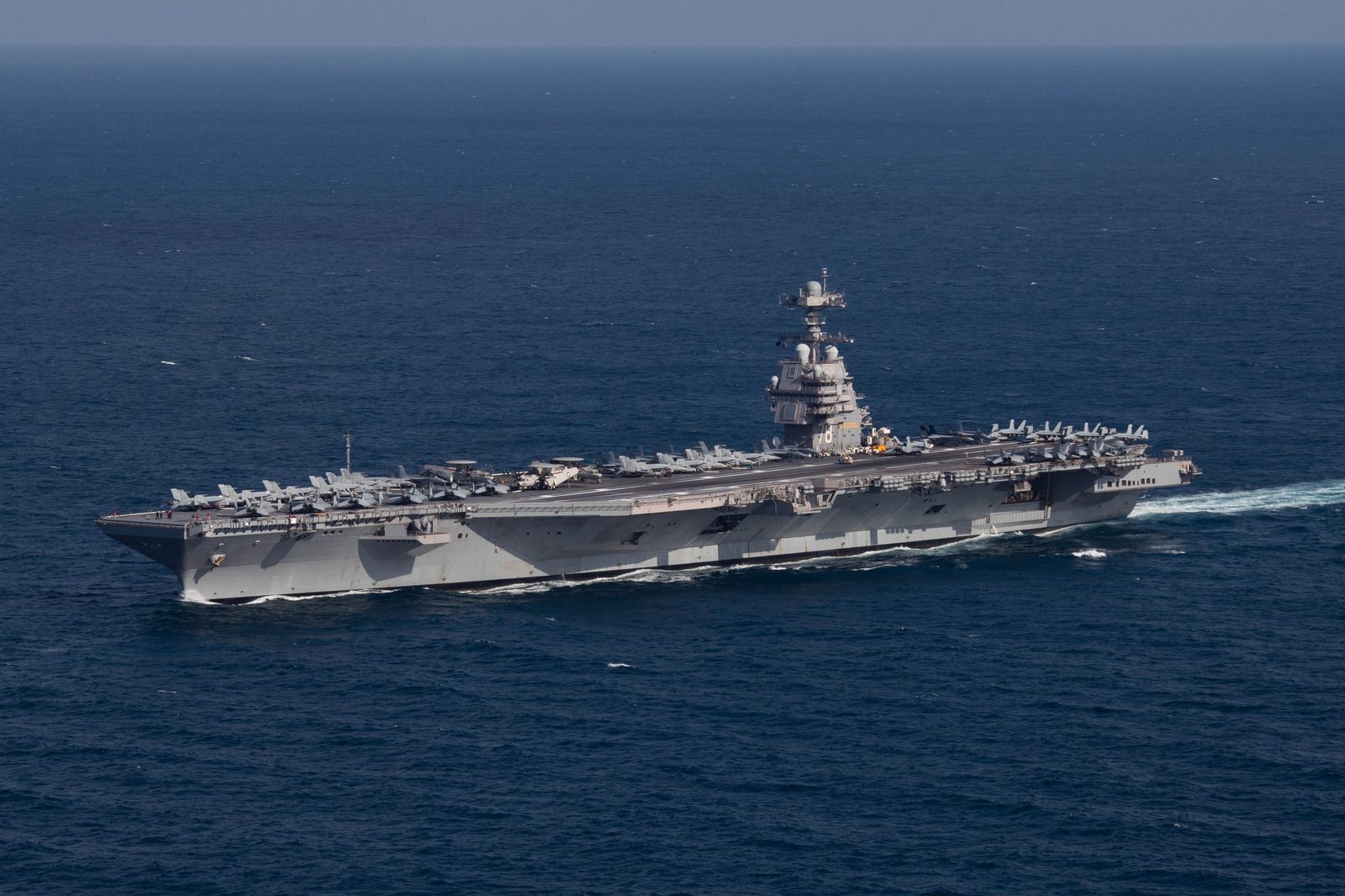
Image: Mass Communication Specialist 2nd Class Jackson Adkins, U.S. Navy, Public Domain (USS Gerald R. Ford (CVN-78) underway in the Atlantic Ocean on 9 October 2022 (221009-N-TL968-1248).JPG)