War ends in a memo pledging $300B to rebuild Iran
The administration says no US taxpayer money funds the $300B - regional partners would, with the mechanism unresolved.
Key facts
- MOU signed June 17, 2026 (Trump + Pezeshkian, Pakistan-mediated)
- Pledges a >=$300B Iran reconstruction plan 'with regional partners' - funding TBD
- Commits US to waivers for Iran's oil exports; frozen Iranian assets to be made available
Summary
On June 17, 2026, Trump and Iranian President Masoud Pezeshkian signed a Pakistan-mediated memorandum of understanding ending the war and reopening the Strait of Hormuz. The MOU says the US 'undertakes, with regional partners, to develop a definitive mutually agreed plan with at least USD 300 Billion' for Iran's reconstruction and economic development, to issue sanctions waivers for Iranian oil exports pending a final deal on terminating sanctions, and to negotiate the release of billions in frozen Iranian assets, with Iran diluting its enriched-uranium stockpile. The $300B pledge became an immediate political flashpoint.
What happened
The framework, reached June 14 and signed June 17, ends a roughly 108-day war and reopens Hormuz, followed by a 60-day window of talks on sanctions and Iran's nuclear program. The headline provision - that the US 'undertakes with regional partners to develop a definitive, mutually agreed plan with at least $300 billion for the reconstruction and economic development' of Iran - drew fierce criticism. Trump wrote 'There is no 300 Billion Dollar payment to Iran by the U.S. That's Fake News!' and VP Vance said the plan would not be 'paid for by American taxpayers' and that 'not a cent of American money goes to Iran,' suggesting regional Arab states and private investors would fund it; the MOU left the 'mechanism for implementation' to the 60-day talks, and no country has confirmed a commitment. The MOU also commits the US to issue waivers for Iranian crude oil and petroleum exports until sanctions are terminated in a final deal, and to make Iran's frozen assets available upon implementation.
Impact on the United States
Despite the headline figure, the MOU commits no confirmed US taxpayer money to the $300B fund - the administration says it will be financed by regional partners and investors, and the mechanism is unresolved. The concrete US commitments are sanctions waivers (allowing Iran to resume oil exports) and the release of Iran's own frozen assets - neither a direct federal outlay. The open questions are the contingent US exposure if regional financing falls short and the precedent of funding reconstruction for an adversary. Returning Iranian crude to market could modestly ease global oil prices.
Global ripple effects
The MOU resolves the 2026 war (see iran-war-hormuz-2026) and the nuclear standoff left by the 2025 strikes (see iran-nuclear-strikes). It reopens Hormuz - with Iran reportedly to impose a transit fee after 60 days - and trades sanctions relief and reconstruction for uranium dilution, reversing years of US maximum-pressure policy.
Documented effects
- MOU signed June 17, 2026 by Trump and Iran's President Pezeshkian, mediated by Pakistan[1]
- Commits the US to help develop a >=$300B Iran reconstruction plan 'with regional partners'; funding mechanism left to a 60-day window[2]
- Trump: 'There is no 300 Billion Dollar payment to Iran by the U.S.'; Vance: 'Not a cent of American money goes to Iran'[2]
- Commits the US to issue waivers for Iranian oil exports until sanctions are terminated in a final deal, and to make Iran's frozen assets available upon implementation[1][2]
- Reopens the Strait of Hormuz; Iran to impose a transit fee after the 60-day period[3]
- The ceasefire lasted only three weeks: after Iran struck ships in Hormuz on July 7, the US rescinded Iran's oil-sales license and Trump declared the ceasefire 'over' on July 8, 2026, and open war resumed (see iran-ceasefire-collapse-2026).[4]
- On Sept. 26, 2026 Trump rejected an Iranian seven-day plan to reopen Hormuz and resume talks, saying "that deal would not be acceptable"; NPR described the plan as similar to the June MOU, and Iran's foreign minister said the US actions it required "are all already in the MoU"[5]
Why this is rated severe
The memorandum paused the 2026 war for three weeks before the ceasefire collapsed. It committed the US to help develop, with regional partners, a plan of at least $300 billion for Iran's reconstruction, to issue sanctions waivers for Iran's oil exports, and to make frozen Iranian assets available - provisions that drew fierce criticism; the administration said no US taxpayer money would fund the plan, and the funding mechanism was never resolved.
the ceasefire collapsed on July 8, 2026 when the US declared it 'over' and strikes resumed - see iran-ceasefire-collapse-2026; the $300B reconstruction fund never materialized
Corrections & updates [6]
Every change to a fact on this page after publication is logged here, newest first.
- CorrectedQuote
Two quotes were not verbatim. The MOU text (NPR) reads: the US 'undertakes, with regional partners, to develop a definitive mutually agreed plan with at least USD 300 Billion, for the reconstruction and economic development' of Iran. Trump's Truth Social post (Al Jazeera) reads: 'There is no 300 Billion Dollar payment to Iran by the U.S. That's Fake News!'[1][2]
- ClarifiedSource
Source metadata corrected to match the published pages: the CFR article is titled "The Iran Deal Reopens the Strait. Much Remains to Be Done." and is dated June 17, 2026; the ABC News timeline is dated July 9, 2026.[3][4]
- UpdatedKey facts
Updated: on Sept. 26, 2026 Trump rejected an Iranian seven-day plan to reopen the Strait of Hormuz and resume talks. NPR describes the plan as similar to the June memorandum; Iran's foreign minister said the steps asked of the US "are all already in the MoU."[5]
- CorrectedSummary
The entry said the MOU "lifts" sanctions on Iran's oil industry. The MOU text (NPR) commits the US to issue waivers for Iranian crude oil and petroleum exports until sanctions are terminated, with termination of all sanctions left to the final deal; the wording now says that. The statement that Iran demanded about $70 billion in compensation is not supported by any cited source and is removed.[1][2][4]
- CorrectedSeverity rationale
The severity rationale said the settlement 'ends the 2026 war', but the record shows the ceasefire collapsed on July 8, 2026; it also described Iran as 'the country it had just bombed'. It now reflects the collapse and describes the provisions neutrally. Severity unchanged.[4]
+ Show previous and current text- Hide previous and current text
- Previously
- The settlement ends the 2026 war but commits the US to help assemble a $300 billion reconstruction plan for the country it had just bombed, commits to sanctions waivers for Iran's oil exports, and opens release of frozen Iranian assets - concessions critics call a strategic and fiscal liability, while the funding mechanism and any US share remain unresolved.
- Now
- The memorandum paused the 2026 war for three weeks before the ceasefire collapsed. It committed the US to help develop, with regional partners, a plan of at least $300 billion for Iran's reconstruction, to issue sanctions waivers for Iran's oil exports, and to make frozen Iranian assets available - provisions that drew fierce criticism; the administration said no US taxpayer money would fund the plan, and the funding mechanism was never resolved.
- CorrectedDisplay copy
The summary attributed the quote 'not a cent of American money' to both Trump and Vance; per the record it was Vance's, while Trump wrote 'There is no 300 Billion Dollar payment to Iran by the U.S.' Each quote is now attributed to its speaker.[2]
+ Show previous and current text- Hide previous and current text
- Previously
- The Islamabad Memorandum paused the war and reopened Hormuz, committing the US to help assemble a $300B reconstruction plan for Iran. Trump and Vance insist 'not a cent of American money' funds it; the mechanism was left to a 60-day negotiation. The US committed to waivers for Iranian oil exports and to free Iran's frozen assets. The ceasefire collapsed three weeks later.
- Now
- The Islamabad Memorandum paused the war and reopened Hormuz, committing the US to help assemble a $300B reconstruction plan for Iran. Trump said there was 'no 300 Billion Dollar payment to Iran by the U.S.' and Vance said 'not a cent of American money' goes to Iran; the mechanism was left to a 60-day negotiation. The US committed to waivers for Iranian oil exports and to make Iran's frozen assets available. The ceasefire collapsed three weeks later.
Sources [5]
- T2NPR - Read the full text of Trump's preliminary U.S.-Iran agreement to end the war · Jun 18, 2026 ↗
- T2Al Jazeera - MoU's $300bn Iran reconstruction fund becomes US political flashpoint · Jun 18, 2026 ↗
- T3Council on Foreign Relations - The Iran Deal Reopens the Strait. Much Remains to Be Done. · Jun 17, 2026 ↗
- T2ABC News - How the US-Iran ceasefire and MOU broke down - a timeline · Jul 9, 2026 ↗
- T2NPR - Trump rejects plan to reopen Strait of Hormuz · Sep 26, 2026 ↗
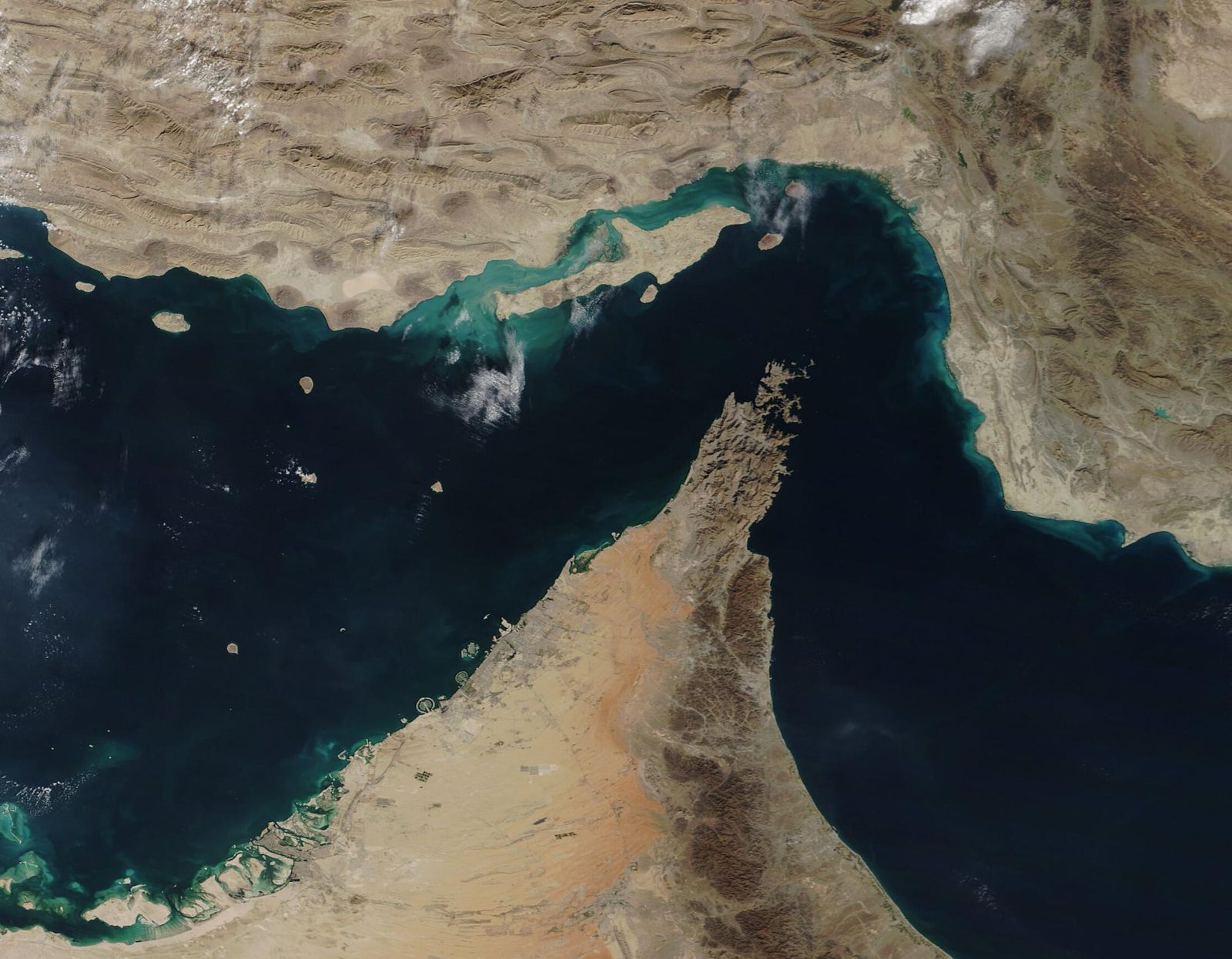
Image: MODIS Land Rapid Response Team, NASA Goddard Space Flight Center, Public Domain (Strait of Hormuz (MODIS 2020-12-04).jpg)