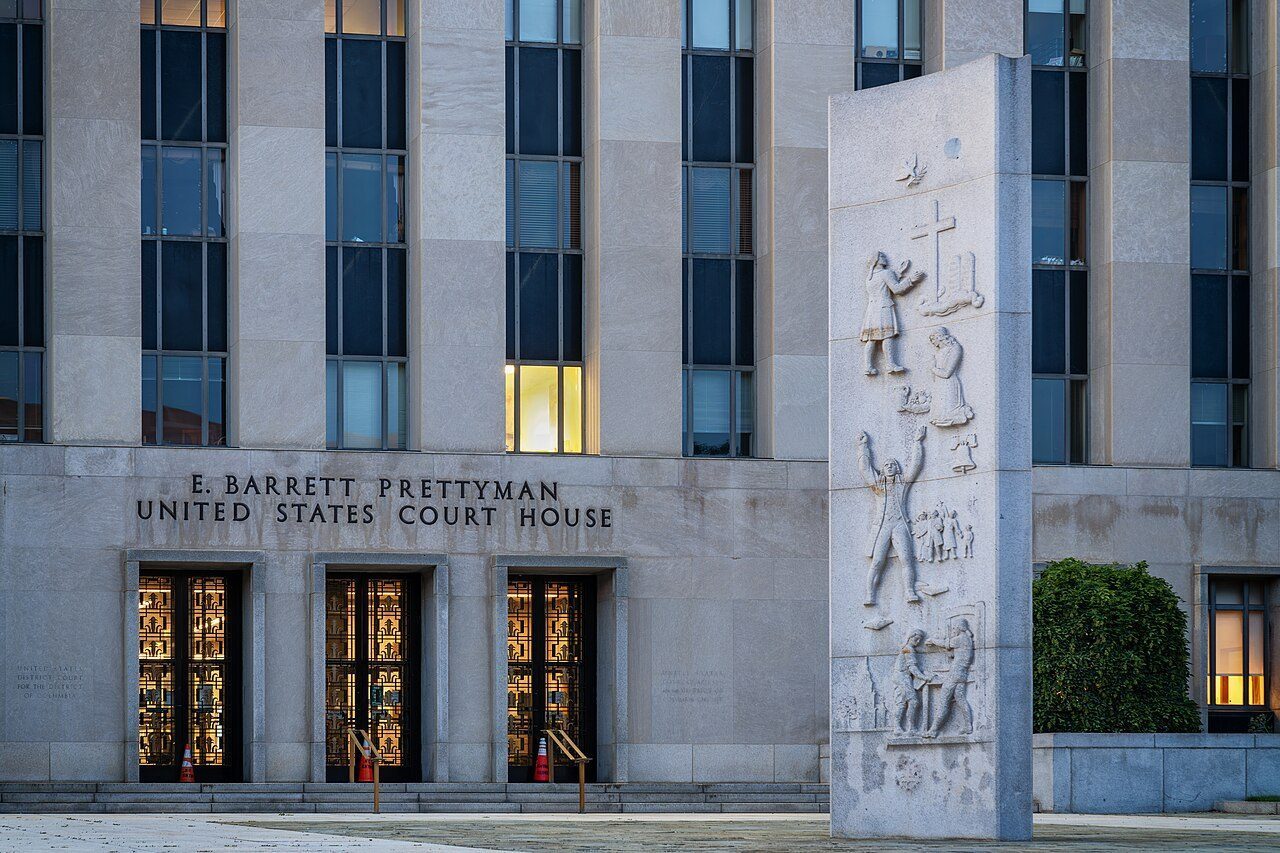
Executive orders target major law firms
Courts struck down every order firms challenged; nine firms instead pledged $940M in free legal work.
Key facts
- Paul Weiss pledged $40M in pro-bono services to settle
- Nine firms, including Paul Weiss, pledged $940M in pro bono work in deals with the White House
- Four senior Paul Weiss litigators departed after its settlement
Summary
Beginning March 6, 2025, Trump signed executive orders targeting major law firms - Perkins Coie, Paul Weiss, Jenner & Block, and WilmerHale - suspending their employees' security clearances, restricting government contracts with clients who retained them, and barring their lawyers from federal buildings. Courts struck down the four orders that firms challenged (Perkins Coie, Jenner & Block, WilmerHale, and Susman Godfrey) as unconstitutional; the Paul Weiss order was revoked after the firm reached a deal with the White House.
What happened
The Perkins Coie EO (March 6) and subsequent orders against Jenner & Block, WilmerHale, and Paul Weiss directed agencies to revoke security clearances, terminate government contracts with firms employing their lawyers, and restrict building access. Paul Weiss capitulated on March 20, pledging $40 million in pro-bono legal services; the capitulation model was replicated by eight additional firms, bringing the total to nine firms and roughly $940 million in pledged pro bono work. Courts blocked the orders: Judge Beryl Howell issued a permanent injunction against the Perkins Coie order on May 2, 2025, finding violations of the First, Fifth, and Sixth Amendments; Jenner & Block and WilmerHale received permanent injunctions in late May 2025.
Impact on the United States
Caused documented chilling effect on legal representation - firms became reluctant to take cases against executive actions. Paul Weiss's capitulation led four prominent litigators (Karen Dunn, Bill Isaacson, Jessica Phillips, Jeannie Rhee) to depart the firm. Bloomberg Law reported that the deals' effect on which cases firms take is hard to track, though some settling firms have continued to litigate against the administration.
Documented effects
- Judge Howell's 102-page permanent injunction (May 2, 2025) found the Perkins Coie EO violated the First Amendment right of association and was unlawful retaliation against protected speech[1]
- Paul Weiss pledged $40 million in pro-bono services (March 20) as blueprint for nine firms collectively pledging $940 million; four senior litigators left the firm[4][6]
- Temporarily blocking the WilmerHale EO on March 28, 2025, Judge Richard Leon wrote: "There is no doubt this retaliatory action chills speech and legal advocacy, or that it qualifies as a constitutional harm."[3]
Why this is rated significant
Targeting major firms produced a documented chilling effect on legal representation, a significant rule-of-law harm though the orders were struck down.
permanent injunctions; DOJ appeals pending at D.C. Circuit
Corrections & updates [6]
Every change to a fact on this page after publication is logged here, newest first.
- CorrectedSummary
Courts struck down only the orders that firms challenged in court (Perkins Coie, Jenner & Block, WilmerHale and Susman Godfrey). The Paul Weiss order was never ruled on: Trump revoked it after the firm agreed to a deal. Figures on the Paul Weiss pledge and the nine-firm $940 million total are now backed by Bloomberg sources; the encyclopedia entry previously cited did not contain them.[4][5][6]
- CorrectedQuote
The quoted phrase 'retaliatory actions based on perceived viewpoint' does not appear in the cited NPR report. NPR quotes Judge Leon's March 28, 2025 temporary restraining order verbatim; the effect now uses that quote.[3]
- CorrectedSummary
The claim that pro bono capacity was 'measurably reduced' as firms shed adversarial work was not supported by a cited source. Bloomberg Law reports the deals' effect on which cases firms take is hard to track, and that some settling firms have kept litigating against the administration.[4]
+ Show previous and current text- Hide previous and current text
- Previously
- Caused documented chilling effect on legal representation - firms became reluctant to take cases against executive actions. Paul Weiss's capitulation led four prominent litigators (Karen Dunn, Bill Isaacson, Jessica Phillips, Jeannie Rhee) to depart the firm. Pro bono capacity in the legal profession was measurably reduced as major firms shed adversarial public-interest work to avoid retaliation.
- Now
- Caused documented chilling effect on legal representation - firms became reluctant to take cases against executive actions. Paul Weiss's capitulation led four prominent litigators (Karen Dunn, Bill Isaacson, Jessica Phillips, Jeannie Rhee) to depart the firm. Bloomberg Law reported that the deals' effect on which cases firms take is hard to track, though some settling firms have continued to litigate against the administration.
- UpdatedStatus
The Justice Department appealed the permanent injunctions to the D.C. Circuit. In March 2026 it moved to drop the appeals, then reversed itself the next day and asked to continue them, so the appeals remain pending.[2]
- Previously
- blocked-by-court
- Now
- blocked-by-court (permanent injunctions; DOJ appeals pending at D.C. Circuit)
- ClarifiedDisplay copy
The key fact called the firms' deals a 'capitulation model'; it now states what the firms agreed to.
- Previously
- Nine firms collectively pledged $940M under capitulation model
- Now
- Nine firms, including Paul Weiss, pledged $940M in pro bono work in deals with the White House
- ClarifiedSource labels
Source tier labels brought in line with the site's tier rule (specialist and trade publications are Tier 3; general news organizations are Tier 2): Bloomberg Law (Tier 2 to 3). No claim in the entry changed.
Sources [6]
- T2CNN - Judge permanently blocks Trump's executive order targeting Democratic-tied law firm Perkins Coie · May 2, 2025 ↗
- T3First Amendment Encyclopedia (MTSU) - Trump's Executive Orders Against Law Firms · Mar 28, 2025 ↗
- T2NPR - In back-to-back rulings, federal judges rule against Trump orders targeting law firms · Mar 28, 2025 ↗
- T3Bloomberg Law - In Trump's $940 Million Deals With Firms, the Jury Is Still Out · Aug 15, 2025 ↗
- T1White House - Addressing Remedial Action by Paul Weiss · Mar 21, 2025 ↗
- T2Bloomberg Tax - Trump Rescinds Paul Weiss Order as Firm Pledges $40 Million · Mar 20, 2025 ↗
Image: Tony Webster, CC BY 2.0 (Wikimedia Commons)