Trump proposes displacing ~2M Gaza residents
Saudi Arabia, Jordan, Egypt, and UAE all rejected the plan within hours.
Key facts
- Saudi Arabia, Jordan, Egypt, UAE rejected plan on day one
- Sen. Graham called it 'problematic at many, many levels'
- Administration continued exploring redevelopment as of Sept 2025
Summary
President Trump publicly proposed that the United States take "long-term ownership" of the Gaza Strip, redevelop it as a "Riviera of the Middle East," and asked Egypt and Jordan to accept Gaza's approximately 2 million Palestinian residents permanently. The proposal was rejected within hours by Saudi Arabia, Jordan, Egypt, and the UAE - all key US security partners.
What happened
Trump announced the plan on approximately February 4, 2025, stating the US would lead Gaza's reconstruction while Jordan and Egypt absorbed its population. Saudi Arabia issued a statement reiterating "firm rejection of any infringement on the legitimate rights of the Palestinian people." Jordan, Egypt, and the UAE expressed similar opposition. European allies expressed shock. Legal scholars questioned whether the plan could be implemented under international law. The next day the White House said residents would be relocated temporarily. In September 2025 a 38-page post-war plan reportedly under consideration by the administration, first disclosed by the Washington Post, envisioned the "voluntary" relocation of Gaza's entire population, at least temporarily, and about a decade of US trusteeship.
Impact on the United States
Arab partners whose intelligence cooperation, base access, and diplomatic support underpin US Middle East strategy - particularly Saudi Arabia and Jordan - publicly distanced themselves from US policy. The episode strained the Abraham Accords normalization process, which depends on Gulf Arab political will to engage with Israel. Even Republican foreign-policy figures such as Sen. Lindsey Graham publicly questioned the proposal, signaling bipartisan concern about US credibility in the region.
Global ripple effects
By aligning the US publicly with mass Palestinian displacement, the administration handed adversaries (Iran, Russia) a narrative weapon used globally to cast the US as violating international law - reducing US ability to invoke rule-of-law arguments in other theaters (Ukraine, Taiwan). Saudi Arabia's stated refusal to proceed with US-brokered normalization unless Palestinian rights were respected created a direct diplomatic barrier to the strategic goal of a Saudi-Israel deal that the US had spent years pursuing.
Documented effects
- Saudi Arabia, Jordan, Egypt, and UAE rejected the proposal within hours of its announcement - February 2025[1]
- European diplomats described "widespread shock" at the proposal[1]
- Sen. Lindsey Graham (R-SC), a Trump ally, said the plan would be "problematic at many, many levels"[1]
- The redevelopment idea evolved into a 20-point peace plan whose first phase, including a ceasefire, began October 10, 2025; phase two was declared in January 2026 and a "Board of Peace" chartered Jan 22, 2026 (Trump as chair); as of June 2026 reconstruction has stalled and the official reconstruction fund had received no donor money[3][4][5][6]
- The Board of Peace unveiled a six-month, $2.45B plan for 66 initial reconstruction projects; of $17B pledged at a February donor conference only $280M has been transferred, and the plan hinges on Hamas handing over its weapons; an International Stabilization Force is to begin with 500 troops from Morocco and Kosovo[7]
Why this is rated limited
A rejected proposal that strained ties with Arab partners but was never implemented, so realized US harm is minimal and reputational.
the redevelopment idea fed into a 20-point peace plan whose first phase, including a ceasefire, began Oct 10, 2025; phase two was declared in Jan 2026 and a "Board of Peace" chartered Jan 22, 2026 with Trump as chair; on Sept 23, 2026 the Board unveiled a $2.45B plan for 66 initial projects, but only $280M of $17B pledged had been transferred and no start date was set
Corrections & updates [5]
Every change to a fact on this page after publication is logged here, newest first.
- CorrectedStatus
The entry described "a Jan 2026 ceasefire". The first phase of the 20-point plan, including the ceasefire, began on October 10, 2025; in January 2026 the US declared phase two (Al Jazeera, Jan 15, 2026), and the Board of Peace charter was signed at Davos on January 22, 2026 with Trump as chair (Al Jazeera). The empty-fund detail now also cites Euronews/AFP (May 27, 2026). The Washington Post source title is corrected to the published headline.[4][5][6]
- CorrectedSource
Sen. Lindsey Graham's "problematic at many, many levels" remark is reported in the NBC News article (s1), not the CNBC article it cited; the NBC article is dated February 5, 2025, not February 1. The whatHappened line saying legal experts cited the Geneva Conventions is not supported by the cited sources; NBC quotes an international-law scholar saying implementation would be "extremely improbable" under international law, and the text now reflects that.[1]
- UpdatedStatus
Updated: on Sept. 23, 2026 the Board of Peace unveiled a six-month, $2.45 billion plan for 66 initial Gaza reconstruction projects. Of $17 billion pledged in February, only $280 million has been transferred, no start date was given, and implementation hinges on Hamas disarming (The Times of Israel).[7]
+ Show previous and current text- Hide previous and current text
- Previously
- partial (the redevelopment idea fed into a 20-point peace plan whose first phase, including a ceasefire, began Oct 10, 2025; phase two was declared in Jan 2026 and a "Board of Peace" chartered Jan 22, 2026 with Trump as chair; as of June 2026 reconstruction has stalled with the official fund empty)
- Now
- partial (the redevelopment idea fed into a 20-point peace plan whose first phase, including a ceasefire, began Oct 10, 2025; phase two was declared in Jan 2026 and a "Board of Peace" chartered Jan 22, 2026 with Trump as chair; on Sept 23, 2026 the Board unveiled a $2.45B plan for 66 initial projects, but only $280M of $17B pledged had been transferred and no start date was set)
- CorrectedSummary
The entry said the administration later walked back the mass-relocation element. The cited sources say otherwise: NBC News reports the White House said the day after the announcement that residents would be relocated temporarily, and CNBC reports that a 38-page post-war plan reportedly under consideration by the administration in September 2025, first disclosed by the Washington Post, envisioned the "voluntary" relocation of Gaza's entire population, at least temporarily, and about a decade of US trusteeship.[1][2]
+ Show previous and current text- Hide previous and current text
- Previously
- Trump announced the plan on approximately February 4, 2025, stating the US would lead Gaza's reconstruction while Jordan and Egypt absorbed its population. Saudi Arabia issued a statement reiterating "firm rejection of any infringement on the legitimate rights of the Palestinian people." Jordan, Egypt, and the UAE expressed similar opposition. European allies expressed shock. Legal scholars questioned whether the plan could be implemented under international law. The administration later walked back the mass-relocation element but continued discussing a redevelopment framework as of September 2025.
- Now
- Trump announced the plan on approximately February 4, 2025, stating the US would lead Gaza's reconstruction while Jordan and Egypt absorbed its population. Saudi Arabia issued a statement reiterating "firm rejection of any infringement on the legitimate rights of the Palestinian people." Jordan, Egypt, and the UAE expressed similar opposition. European allies expressed shock. Legal scholars questioned whether the plan could be implemented under international law. The next day the White House said residents would be relocated temporarily. In September 2025 a 38-page post-war plan reportedly under consideration by the administration, first disclosed by the Washington Post, envisioned the "voluntary" relocation of Gaza's entire population, at least temporarily, and about a decade of US trusteeship.
- ClarifiedDisplay copy
Matched the record: legal scholars questioned whether the plan could be implemented under international law.
+ Show previous and current text- Hide previous and current text
- Previously
- Trump publicly proposed US 'long-term ownership' of Gaza and asked Egypt and Jordan to permanently accept its approximately 2 million residents. Arab allies immediately rejected the plan; legal experts noted potential international law violations.
- Now
- Trump publicly proposed US 'long-term ownership' of Gaza and asked Egypt and Jordan to permanently accept its approximately 2 million residents. Arab allies immediately rejected the plan; legal scholars questioned whether it could be implemented under international law.
Sources [7]
- T2NBC News - Trump's plans for a 'riviera of the Middle East' in Gaza condemned by America's allies · Feb 5, 2025 ↗
- T2CNBC - Gaza Riviera: Trump administration weighs post-war redevelopment plan · Sep 1, 2025 ↗
- T2Washington Post - Lacking money and support, Trump's Board of Peace stalls in Gaza · Jun 1, 2026 ↗
- T2Al Jazeera - Israel kills six in Gaza as US declares phase two of peace plan launched · Jan 15, 2026 ↗
- T2Euronews (AFP) - Trump Board of Peace's official Gaza reconstruction fund is empty, source says · May 27, 2026 ↗
- T2Al Jazeera - Trump launches Board of Peace at ceremony in Davos · Jan 22, 2026 ↗
- T2The Times of Israel - Board of Peace unveils $2.4B Gaza recovery plan, but hurdles remain before implementation · Sep 23, 2026 ↗
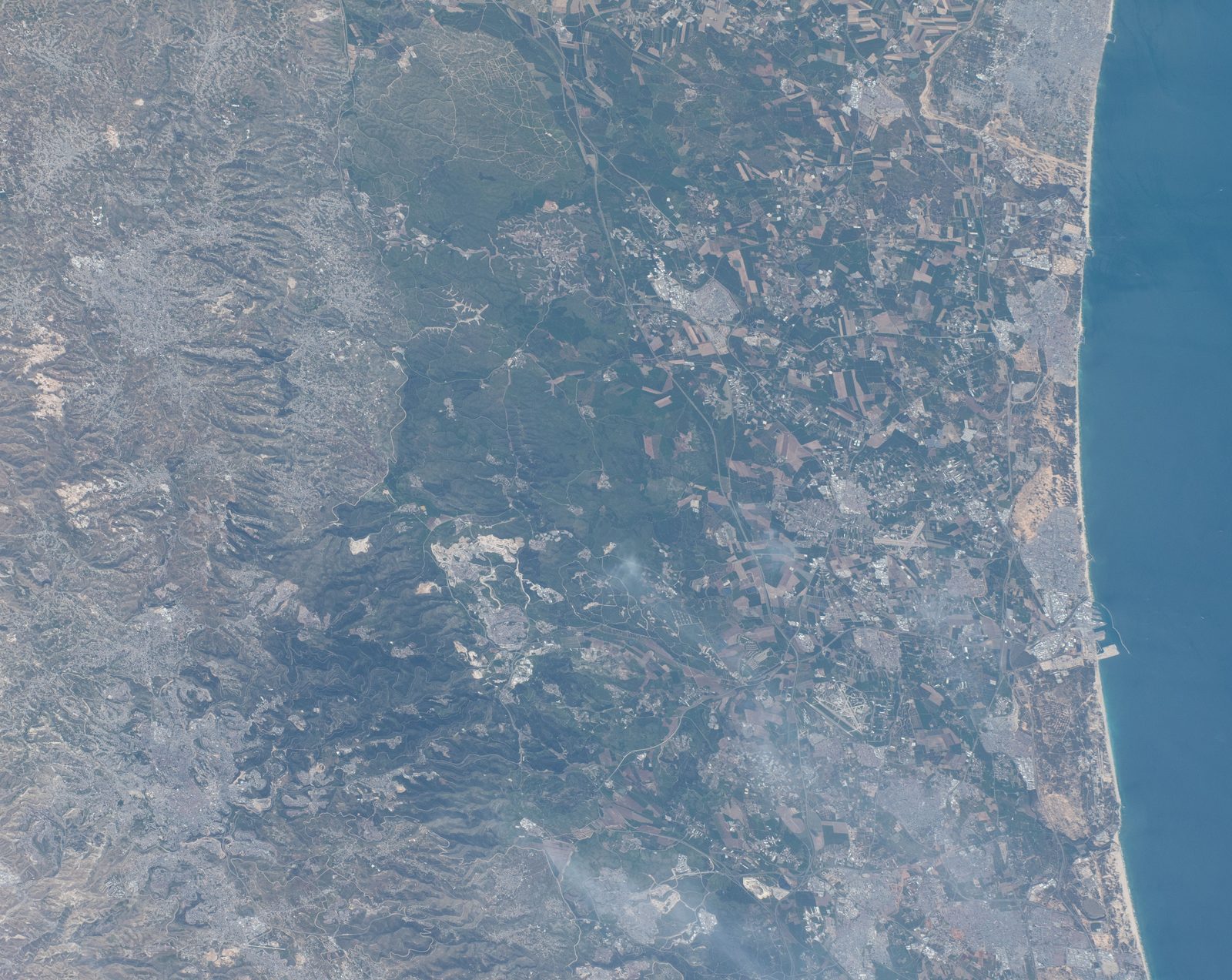
Image: NASA Johnson Space Center / Earth Science and Remote Sensing Unit, Public Domain (ISS062-E-124837_-_View_of_Earth_-_Jerusalem_-_Kiryat_Gat_-_Gaza_Strip_-_Ashdod_-_Mediterranean_Sea_(cropped).jpg)